Quick Answer An SEO RFP (Request for Proposal) is a structured document you send to candidate SEO agencies asking them to bid on your project. A good SEO RFP includes 12 sections: company background, project objectives, target audience, current state, scope of work, deliverables, timeline, budget
Quick Answer
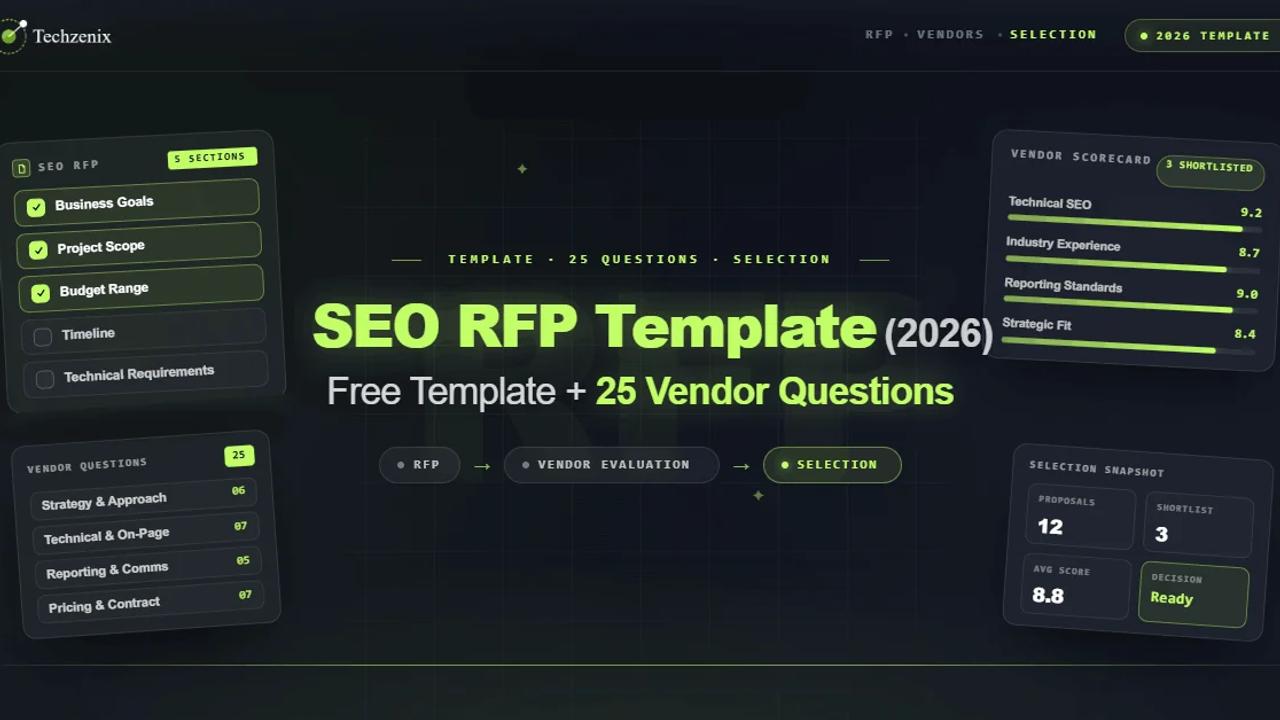
An SEO RFP (Request for Proposal) is a structured document you send to candidate SEO agencies asking them to bid on your project. A good SEO RFP includes 12 sections: company background, project objectives, target audience, current state, scope of work, deliverables, timeline, budget range, evaluation criteria, vendor questions, submission requirements, and contract terms. The complete copy-and-paste template is in section 4 of this post. No email gate, no PDF download. Most SEO RFPs are too vague to produce comparable bids — this template fixes the most common gaps.
If you have ever sent a vague SEO RFP and received six agency responses that you could not compare to each other, you are not alone. Most SEO RFPs fail because they ask broad questions, hide the budget, and skip the criteria buyers actually use to make the decision. The result is wasted time on both sides and a hire based on a sales pitch rather than the work.
This post fixes that. You get the complete SEO RFP template in section 4, written so you can copy it directly into a Google Doc and edit. Plus the 25+ specific questions worth asking, the scoring rubric to evaluate responses, the red flags to disqualify on, and the realistic timeline for the full process.
If you have not yet decided whether to hire an agency at all, start with our pillar guide on how to hire a digital marketing agency before going through this RFP process. If you have already committed to running an RFP, continue below.
Free 24-Hour Audit
Skip the RFP Process and Get a Direct Proposal Instead
If you want to compare just one strong proposal before going through a full RFP, request a free 24-hour audit and custom proposal from Techzenix. No commitment, no sales call required.
1. What is an SEO RFP and why send one?
An SEO RFP (Request for Proposal) is a structured document you send to multiple SEO agencies asking them to bid on your search engine optimization project. The RFP defines the scope, your context, your goals, your evaluation criteria, and a set of specific questions you want answered. Each agency responds with a proposal that addresses your requirements directly.
The point of an RFP is not bureaucracy. It is to produce comparable proposals from multiple agencies so you can make the decision based on substance, not on whoever has the best closing pitch.
What an SEO RFP does that informal vetting does not
2. When you should send an SEO RFP (and when not to)
An SEO RFP is the right tool in some situations and the wrong tool in others. Knowing the difference saves both you and the agencies a lot of time.
When an SEO RFP makes sense
- Your annual SEO budget will be $50,000 or more
- Multiple stakeholders need to sign off on the agency selection
- You are switching from one agency to another and want to benchmark
- Your company has procurement or finance policies that require formal bidding
- You are entering a new market or scope where you need expert input on approach
- You need legal or compliance language (NDAs, MSAs) embedded in the proposal
When an SEO RFP is overkill
- Your annual SEO budget is under $30,000 (the process cost outweighs the benefit)
- You already have a strong shortlist of 2 or 3 agencies from referrals
- You need to move fast (urgent recovery work, time-sensitive launch)
- Your scope is small or single-project (audit, content sprint, technical fix)
- You are at an early stage and your goals are still being defined
In smaller scope situations, a structured proposal request (less formal than an RFP) usually works better. You can use the same questions from this post without the full procurement-style framing. For a list of the highest-value vetting questions to use in any size engagement, see 20 questions to ask before hiring a digital marketing agency.
3. The 12 essential sections of an SEO RFP
Every effective SEO RFP includes the same 12 sections. The full copy-paste template is in section 4. The breakdown below explains why each section matters and what to include.
Section 1: Company background
Briefly describe your business: industry, products or services, company size, locations served, and current marketing maturity. Agencies need this context to estimate scope accurately.
Section 2: Project objectives
State the specific outcomes you want from this SEO engagement. Be measurable: “increase organic traffic by 40 percent in 12 months” beats “improve SEO performance.” Three to five objectives is the right count.
Section 3: Target audience
Describe who you are trying to reach. Demographics, firmographics for B2B, geographic concentration, search behavior if you know it. This shapes the keyword strategy agencies will propose.
Section 4: Current state
Share what is working and what is not. Current traffic, current ranking keywords if you know them, prior SEO work or agencies, technical issues you are aware of. The more honest this section is, the better the proposals will be.
Section 5: Scope of services
List the specific SEO services you want included. Technical SEO, on-page optimization, content production, link building, local SEO, international SEO, conversion rate optimization. Be specific about what is in scope and what is out.
Section 6: Deliverables
State the tangible outputs you expect: monthly reports, audit deliverables, content quantities, link targets, training sessions. This is where vague RFPs lose the most signal.
Section 7: Timeline
Two timelines: the RFP process timeline (when responses are due, when finalists will be selected, when work begins) and the engagement timeline (start date, key milestones, contract length).
Section 8: Budget range
Share a budget range, even if you keep it broad. Agencies cannot scope appropriately without this. The most common mistake in SEO RFPs is hiding the budget; the result is wildly different proposals that you cannot compare.
Section 9: Evaluation criteria
Tell agencies how you will score proposals. Common criteria: relevant experience (25%), strategic approach (25%), team and capabilities (20%), pricing and value (15%), cultural fit (15%). Publishing this in the RFP makes responses more focused.
Section 10: Vendor questions
The list of specific questions you want each agency to answer. Section 5 of this post contains the 25+ questions worth using.
Section 11: Submission requirements
Format, length, contact for submission, deadline, what to include (case studies, team bios, references, sample reports). Standardize this so responses are comparable.
Section 12: Contract terms and legal
Any non-negotiable contract terms (NDA, IP ownership, termination clauses), payment terms, and reference to your standard MSA if you have one. This filters out agencies that cannot work within your legal requirements.
4. Free SEO RFP template you can copy
Below is the complete SEO RFP template. Copy it into a Google Doc or Word document, replace the bracketed placeholders with your specific details, and send it to your shortlisted agencies. No email gate, no PDF download required.
SEO RFP TEMPLATE — [Your Company Name]
[Logo / letterhead]
REQUEST FOR PROPOSAL: SEO Services
| Issue date: | [Date issued] |
| Response deadline: | [Date — typically 2-3 weeks from issue] |
| Project start date: | [Target start date] |
| Issued by: | [Your name, role, company] |
| Contact: | [Email + phone for questions] |
1. Company Background
[Your company name] is a [industry, e.g. B2B SaaS / eCommerce / professional services] company headquartered in [city, country] with [number] employees and approximately [revenue range, e.g. $5M-$10M] in annual revenue.
We serve [target customer description] in [geographic markets].
Our website is [URL]. Our current monthly organic traffic is approximately [number] visitors. Our marketing team consists of [number] internal staff [list roles].
Our primary competitors in search include [list 3-5 competitor domains].
2. Project Objectives
Through this SEO engagement, we are looking to achieve the following measurable outcomes within 12 months of engagement start:
- Objective 1: [e.g. Increase organic traffic by 40% from the current baseline of X to Y monthly sessions]
- Objective 2: [e.g. Generate 50 qualified leads per month from organic search, up from current X]
- Objective 3: [e.g. Achieve top-5 rankings for 20 priority commercial keywords]
- Objective 4: [e.g. Improve domain authority from current X to Y]
- Objective 5: [e.g. Capture share of voice in AI search engines for our top 10 brand-defining queries]
3. Target Audience
- Primary audience: [e.g. Marketing directors at B2B SaaS companies with 50-500 employees in the US and UK]
- Secondary audience: [e.g. CMOs at growth-stage companies actively evaluating marketing technology]
- Geographic concentration: [e.g. US (60%), UK (25%), Canada/Australia (15%)]
- Known search behavior: [If you have analytics data on what your audience searches, share top queries and intent patterns]
4. Current State
Current SEO setup:
- Current agency: [Name or 'none' or 'in-house team']
- Engagement length: [How long]
- Monthly investment: [Approximate spend]
- What's working: [List 2-3 positive outcomes]
- What's not working: [List 2-3 problem areas]
Technical context:
- Platform: [e.g. WordPress, Shopify, custom React, Webflow]
- Site size: [Approximate page count]
- Known issues: [Any technical SEO issues you're aware of]
Content context:
- Current content volume: [Number of pages, articles, etc.]
- Content production: [Who currently produces content and at what rate]
Recent SEO history:
- Algorithm impact: [Any recent ranking changes you've noticed]
- Prior work: [Audits done, recommendations implemented]
5. Scope of Services
We are looking for an SEO partner to handle the following scope:
In scope:
- Technical SEO audit and ongoing technical optimization
- Keyword research and content strategy
- On-page optimization for existing and new pages
- Content production ([X] pieces per month)
- Link building and digital PR
- Local SEO (if applicable)
- International SEO (if applicable)
- AI search visibility (Generative Engine Optimization / GEO)
- Monthly reporting and analytics
- Conversion rate optimization advisory
Out of scope:
- [List anything explicitly out of scope]
Tools we currently use: [List your current tool stack]
Tools we expect the agency to bring: [Specify if you want agency to provide tools or use yours]
6. Deliverables
Month 1:
- Comprehensive technical SEO audit
- Keyword research and content strategy document
- Competitive analysis report
- Quarterly roadmap
Ongoing (each month):
- [X] blog posts / content pieces (specify word count and format)
- [X] on-page optimizations on existing pages
- [X] earned backlinks from sites with DR [X]+
- Monthly performance report including: [list specific KPIs]
- One strategic review call per month
Quarterly:
- Strategic roadmap update
- Competitive landscape review
- Executive summary for leadership
7. Timeline
RFP process timeline:
- RFP issued: [Date]
- Vendor questions deadline: [Date — typically 5 business days after issue]
- Question responses sent to all bidders: [Date]
- Proposal submission deadline: [Date — typically 2-3 weeks after issue]
- Shortlist notification: [Date]
- Finalist presentations: [Date range]
- Decision and award: [Date]
- Contract signed: [Date]
- Engagement start: [Date]
Engagement timeline:
- Initial contract length: [12 months recommended]
- Notice period for termination: [30-60 days standard]
- Renewal terms: [How renewal is handled]
8. Budget Range
Our budget range for this engagement is [$X] to [$Y] per month, or [$XX,000] to [$YY,000] annually for the agency fee.
This budget excludes:
- Ad spend (if any paid media is included)
- Third-party tool licenses we don't already own
- Travel costs for in-person meetings (if requested)
Please indicate clearly in your proposal which costs are included in your fee and which are billed separately.
9. Evaluation Criteria
We will evaluate proposals against the following weighted criteria:
- Relevant experience and case studies (25%)
- Strategic approach and proposed methodology (25%)
- Team composition, capabilities, and named team members (20%)
- Pricing structure and value (15%)
- Cultural fit and communication style (15%)
Pricing is not weighted highest because we are optimizing for outcomes, not lowest cost. Strong strategic approach and proven results carry more weight.
10. Vendor Questions
Please respond to each of the questions below in your proposal. (Full question set is in section 5 of this post — 25+ questions covering experience, strategy, team, reporting, and contract terms.)
11. Submission Requirements
Format: PDF document, maximum 30 pages including appendices
Length: Suggested 15-25 pages of substance plus appendices
Must include:
- Executive summary (1 page)
- Response to each vendor question (in question order)
- Proposed strategic approach
- Team bios for the named team members
- 2-3 detailed case studies from similar engagements
- Detailed pricing breakdown
- 3 client references with permission to contact
- Sample reporting deliverable
- Draft scope of work for first 90 days
Submit to: [Email address]
Subject line: [Your Company Name] SEO RFP Response — [Agency Name]
Questions during the bidding period should be sent to [Email]. We will batch responses and send to all bidders simultaneously to keep the process fair.
12. Contract Terms and Legal
Required contract terms:
- NDA execution before sharing detailed proposal content (template attached)
- Mutual termination clause with [30 or 60] day notice period
- Monthly invoicing with Net [15 or 30] payment terms
- IP ownership: All content, deliverables, and assets produced for [Your Company] become our property upon payment
- Liability cap appropriate to engagement size
- [Any other legal requirements specific to your company]
Our standard MSA is [attached / available upon request]. Selected agency will be expected to execute or negotiate from this template.
[Signature block for issuing person]
Pro Tip
How to use this template
Copy each box above into a single Google Doc or Word document. Replace every bracketed placeholder with your specific details. Customize the scope, deliverables, and contract sections to your situation. Total RFP length will be 8 to 15 pages. Send to 4 to 6 agencies maximum; more than 6 wastes everyone's time and dilutes attention from each bidder.
5. 25+ vendor questions to include in your SEO RFP
These are the questions that produce the most useful agency responses. Pick 15 to 25 for your RFP based on what matters most for your scope. Group them by category.
Experience and track record (pick 5)
- Describe 3 SEO engagements completed in the past 24 months for clients similar to us in size, industry, or scope. Include the strategic approach, measurable results, and client name (where permission allows).
- What is your average client tenure and what percentage of clients renew at the end of their initial contract?
- Provide 3 client references we can speak with, including their direct contact information.
- How many active clients does your agency currently serve, and how many would be at our budget level or higher?
- What industries do you have the deepest expertise in, and is ours one of them?
Strategic approach (pick 5)
- Walk us through the strategic approach you would propose for our specific objectives. What would you prioritize in the first 90 days and why?
- How do you approach keyword research and prioritization for a client at our stage?
- How do you balance technical SEO, content production, link building, and AI search visibility in a typical engagement at our budget level?
- What is your approach to AI search engines and Generative Engine Optimization (GEO)?
- How would you adapt your strategy if [a likely scenario for our business — e.g. Google algorithm update, competitor entering market, budget cut]?
Team and capabilities (pick 4)
- Who specifically will work on our account? Provide names, LinkedIn profiles, and time allocation percentages. Include the strategic lead, technical SEO lead, content lead, and account manager.
- What is the seniority level of the day-to-day account team versus the strategic lead?
- How is work supervised internally? What is the review and quality control process?
- If our primary account contact leaves your agency mid-engagement, how is continuity handled?
Reporting and communication (pick 4)
- Share a redacted example of the monthly reporting you would deliver. What metrics are tracked, and how are they presented?
- What is your standard communication cadence with clients (weekly calls, monthly reviews, ad-hoc Slack/email)?
- How do you handle out-of-scope requests or projects that arise during the engagement?
- What is your typical response time for client questions during business hours?
Pricing and contract (pick 5)
- Provide a detailed pricing breakdown for the proposed scope. Include monthly retainer, any one-time onboarding fees, and what is billed separately (tools, ad spend, third-party costs).
- What is your standard contract length and termination notice period?
- Do you offer discounts for annual prepayment or longer commitments?
- What is your standard annual price increase at renewal?
- Are there any conditions under which your pricing model would change mid-engagement?
Risk and accountability (pick 3)
- Describe a recent client engagement that did not meet expectations and what you learned from it.
- Have you ever lost rankings or traffic for a client due to an SEO tactic you used? What happened and how was it resolved?
- What guarantees or service-level commitments do you make, and what happens if they are not met?
For a deeper list of vetting questions (some of which overlap with these and some that go further), see our companion post on the 20 questions to ask before hiring a digital marketing agency.
Free Proposal
Want to See How Techzenix Would Answer These Questions?
Send us your SEO RFP and we will respond within 5 business days with a complete proposal addressing every question above. No obligation to choose us.
6. The SEO RFP timeline (week by week)
A typical SEO RFP process takes 4 to 6 weeks from issue to contract signing. Here is the realistic week-by-week breakdown.
Total internal time investment: 40 to 65 hours across stakeholders. For a $100,000+ annual engagement, this is reasonable due diligence.
7. How to evaluate SEO RFP responses with a scoring rubric
The most useful single artifact in any RFP process is a scoring rubric agreed by stakeholders before responses arrive. The rubric below uses the 5 weighted criteria from section 9 of the template.
Total score is calculated as (criterion score × weight) summed across all 5 criteria. Maximum possible is 10.0; in practice, top scores cluster between 7.5 and 8.5. A score of 8.0 or higher is a strong finalist.
How to use the rubric
- Each stakeholder scores each proposal independently using the rubric. Aggregate scores after individual review, not before.
- Discuss any criterion where stakeholders scored 2+ points apart. This is where the most useful conversation happens.
- Do not adjust weights after responses arrive. Doing so reverse-engineers the rubric to favor a predetermined choice.
- If two proposals are within 0.3 points of each other, treat them as effectively tied. Use the finalist presentations to break the tie, not the rubric.
8. Red flags in SEO RFP responses
Some response patterns are clear disqualifiers, regardless of how strong the overall proposal looks. Watch for these.
- Guarantees of specific rankings or traffic numbers. Per Google’s official guidance on hiring SEO, “No one can guarantee a #1 ranking on Google.” Any agency promising this is using risky tactics or misrepresenting capability.
- Refusal to name the actual team members. If the proposal lists “a dedicated team” without names, you cannot verify who you would be working with. Often the senior people you meet during sales do not work on the account afterward.
- Inability to reference real client work. Vague success stories without specifics, named clients, or willingness to provide references suggests the work cannot withstand scrutiny.
- No mention of AI search engines or GEO. In 2026, an SEO agency that doesn’t address AI search visibility is competing with outdated thinking. Search Engine Journal’s coverage of GEO trends establishes this as a baseline expectation.
- Pricing that is significantly below benchmark. A proposal 50%+ below your other quotes for the same scope is either misunderstanding the scope or planning to deliver a fraction of what they promised.
- Black-box methodology. If the agency cannot or will not explain exactly what they do, you have no way to evaluate whether their approach is sound. Transparency about methodology is non-negotiable.
- Contracts with no exit clause under 30 days. Industry standard is 30 to 60 day notice within any contract length. Anything less protects the agency, not the relationship.
For the complete list of warning signs in agency hiring (extending beyond RFP responses to the broader hiring process), see our deep dive on the 12 red flags when hiring a digital marketing agency.
9. 8 common SEO RFP mistakes to avoid
Even with a good template, the process can go wrong. The eight mistakes below are the most common reasons SEO RFP processes produce weak hires.
Mistake 1: Hiding the budget
The most common mistake. Buyers hide the budget thinking it will produce more competitive pricing. The actual result is wildly different proposals that cannot be compared, agencies guessing at scope, and the wrong agencies bidding for your work. Share a budget range, always.
Mistake 2: Sending the RFP to too many agencies
Send to 4 to 6 agencies maximum. More than 6 and you cannot give each response the attention it deserves. More than 8 and agencies sense the dilution and de-prioritize your RFP, which means you get B-team responses.
Mistake 3: Asking generic questions
“Tell us about your SEO services” produces brochure responses. “Walk us through the strategic approach you would propose for our specific objectives, prioritizing the first 90 days” produces useful responses. Specific questions force specific answers.
Mistake 4: Skipping the evaluation criteria section
Without published criteria, every agency optimizes their response for what they assume you care about. With published criteria, every agency addresses what you actually care about. The 5 minutes to publish criteria save 5 hours of comparison work later.
Mistake 5: No internal alignment before issue
If stakeholders haven’t agreed on objectives, scope, and budget before the RFP goes out, every internal conversation during scoring re-litigates the foundation. Run a 60-minute internal alignment meeting before issuing the RFP.
Mistake 6: Picking the cheapest proposal
SEO is a discipline where price-quality correlation is real. The cheapest proposal is almost never the best value because the work behind it is either thinner than promised or executed by junior staff. Use the rubric, not just price.
Mistake 7: Skipping reference checks
References are the single highest-signal step in the process. Skip them and you are buying based on the agency’s marketing rather than their actual track record. 30 minutes with two references tells you more than 8 hours reading proposals.
Mistake 8: No final negotiation step
The original proposal is almost never the final terms. Pricing, scope, contract length, and KPIs are all negotiable. Treat the proposal as the starting point for a 1 to 2 week negotiation rather than the final answer.
10. How agencies actually respond to your SEO RFP
Knowing how agencies handle RFPs from the inside helps you write a better one. Three patterns worth understanding.
Pattern 1: Agencies triage RFPs aggressively
A mid-size agency receives 5 to 20 RFPs per month. They invest 8 to 20 hours per response on the ones they take seriously, and they decline or send templated responses to the rest. The signals that get an RFP taken seriously: clear budget, named contact, specific objectives, reasonable timeline, and evidence that the buyer has done their homework. A well-written RFP gets the A-team response; a sloppy RFP gets a B-team response or a polite decline.
Pattern 2: The proposal you read was written in 8 to 20 hours
A typical SEO RFP response involves a senior strategist (the lead), an account manager (writing most of the content), one or two specialists (contributing technical or tactical sections), and a junior researcher (doing competitive analysis and case study selection). The most senior person you meet during the sales process may have written less than 20 percent of the proposal.
Pattern 3: Most proposals say similar things
90 percent of SEO proposals describe similar methodologies in similar language: audit, keyword research, on-page, content, links, reporting. The difference between agencies is in how they execute, not in what they propose. This is why reference checks and case study depth matter more than proposal narrative.
11. How Techzenix approaches SEO RFPs
Since this is our blog, here is the inside view of how we respond to SEO RFPs. We respond to RFPs that match our scope and decline politely to the ones that do not. Our standard response timeline is 5 to 10 business days from receipt of a complete RFP. If you would like to see the full range of services we cover, our SEO services overview describes our standard scope.
What we always include in our SEO RFP responses
- Named team members. Strategist, technical SEO lead, content lead, account manager. With time allocation and LinkedIn profiles.
- Specific approach for your situation. Not a template. A 90-day roadmap calibrated to your current state and objectives.
- Detailed pricing breakdown. Monthly retainer, onboarding fee (if applicable), what’s included, what’s billed separately.
- Real case studies. From clients in similar industries or at similar scale, with named results where permission allows.
- 3 referenceable clients. With contact info, ready for you to speak with.
- AI search visibility section. How we approach GEO and AI search engine citations as part of standard scope.
- Honest assessment of fit. Including any reasons we think a different agency might be a stronger match.
What we will not include
- Guaranteed rankings or specific traffic numbers
- Generic methodology descriptions that could apply to any client
- Hidden costs that emerge after contract signing
- Anonymous team descriptions
If you want to see how our pricing structure works before sending an RFP, see our detailed guide on digital marketing agency pricing and our breakdown of how much a digital marketing agency costs.
Conclusion and final thoughts
A good SEO RFP is the difference between hiring an agency based on a sales pitch and hiring based on substance. The template, questions, and scoring rubric in this post are designed to be used directly. Copy them, customize them to your situation, and send them to your shortlist.
Three takeaways worth keeping after closing this post:
- Specificity beats comprehensiveness. A 10-page RFP with specific questions and a published rubric produces better responses than a 30-page RFP with generic asks. Tightly scoped requests get tightly scoped answers.
- Share the budget. The biggest single improvement most buyers can make is publishing their budget range. The fear that sharing the budget produces inflated quotes is mostly false; the reality is that hiding the budget produces unusable comparisons.
- Reference checks matter more than proposals. Two 30-minute calls with real references tell you more than 8 hours of proposal reading. Build references into the process explicitly and weight them heavily.
Once you have selected an agency through this process, the work begins. For preparing your team and operations for the engagement, see our pillar guide on how to hire a digital marketing agency. For the wider context of evaluating pricing across bids, see our guide on digital marketing agency pricing in 2026.
And if you are weighing whether to use an agency at all versus building internally, our analysis of in-house marketing versus agency covers the full math.
Custom SEO Proposal
Want a Custom SEO Proposal from Techzenix?
Send us your SEO RFP using the template above, or skip the RFP and request a direct custom proposal. Either way, we respond within 5 business days with a complete proposal addressing your specific situation.
Frequently asked questions
What is an SEO RFP?
An SEO RFP (Request for Proposal) is a structured document sent to multiple SEO agencies asking them to bid on a search engine optimization project. The RFP defines scope, objectives, evaluation criteria, and specific questions, producing comparable proposals from each bidder.
How long should an SEO RFP be?
Most effective SEO RFPs are 8 to 15 pages. Long enough to be comprehensive, short enough that bidders read the whole thing. Anything under 5 pages typically lacks the detail needed for good proposals; anything over 20 pages creates fatigue.
How many agencies should I send my SEO RFP to?
Send to 4 to 6 agencies maximum. More than 6 dilutes the attention each agency gives your RFP, which means weaker responses. Less than 3 doesn’t give you enough comparison signal.
Should I share my budget in the SEO RFP?
Yes, almost always. Hiding the budget produces wildly different proposals that cannot be compared and forces agencies to guess at scope. Share a budget range; agencies will scope appropriately within it. The fear that sharing the budget will produce inflated quotes is mostly unfounded for professional agencies.
How long does an SEO RFP process take?
4 to 6 weeks from RFP issue to contract signing. Week 1: issue. Week 2: clarifying questions. Week 3: proposals arrive. Week 4: shortlist. Week 5: finalist presentations and references. Week 6: decision and contract.
What hidden costs should I watch for?
Eight common hidden costs: ad spend separate from management fees, tool subscriptions not included, onboarding fees, content asset licensing, rush fees, out-of-scope change orders, annual price increases, and termination fees. Get total monthly investment in writing before signing.
How much internal time does an SEO RFP take?
Paid media shows results in 2 to 12 weeks. SEO and content show material results at 6 to 9 months. Email and conversion optimization show results at 2 to 6 months. Per Google’s own guidance on hiring SEO, SEO needs four months to a year to show meaningful benefits.
Can I run an SEO RFP for a small budget?
Below $30,000 annual SEO budget, a formal RFP usually isn’t worth the process cost on either side. A simpler structured proposal request using the same questions works better. Above $50,000 annually, a formal RFP is worth the investment.
What is the difference between management fees and ad spend?
The agency’s management fee pays for their time and expertise managing your campaigns. Ad spend pays Google, Meta, LinkedIn, or other platforms to run the ads themselves. A $3,000 monthly management fee plus $5,000 monthly ad budget equals $8,000 total monthly investment. Always clarify which is which before signing.
Should I include current performance data in my SEO RFP?
Yes. Share current organic traffic, top-ranking keywords if you know them, prior SEO work, and any technical issues you are aware of. The more honest this context is, the better the proposals will be. Vague current-state sections produce vague proposed approaches.
What if my company requires NDAs before sharing the RFP?
Include the NDA requirement in your initial outreach to candidate agencies. Most agencies execute NDAs routinely. Build NDA execution into the RFP timeline so it doesn’t delay the substantive work.
How do I evaluate proposals fairly?
Use a published scoring rubric with weighted criteria (see section 7 above). Have multiple stakeholders score independently before discussing. Stick to the weights you set before responses arrived. Discuss criteria where scores diverge significantly across stakeholders.
What should I do after selecting the winning agency?
Three steps. First, give other bidders a respectful decline with brief feedback (this protects future RFP responses). Second, negotiate the final contract before signing (pricing, scope, KPIs, and terms are all negotiable). Third, plan the first 90 days carefully to give the new engagement the best chance of momentum.
Can I skip the RFP and just hire an agency directly?
Yes, for smaller engagements, time-sensitive work, or when you have a strong existing relationship. The RFP exists to produce comparable bids; if you don’t need comparison (because you have a referral or existing trust), skipping the RFP is rational.
Free 24-Hour Audit
Ready to Receive Your First Strong SEO Proposal?
Send us your RFP using the template above, or skip the formal process entirely and request a free 24-hour audit plus custom proposal. We respond within 5 business days either way.

Ali Hamza is an SEO specialist and digital marketer with 7+ years of experience in SEO, content strategy, WordPress, and online growth marketing. He shares practical insights and industry-based strategies focused on improving search visibility, user experience, and long-term organic growth.