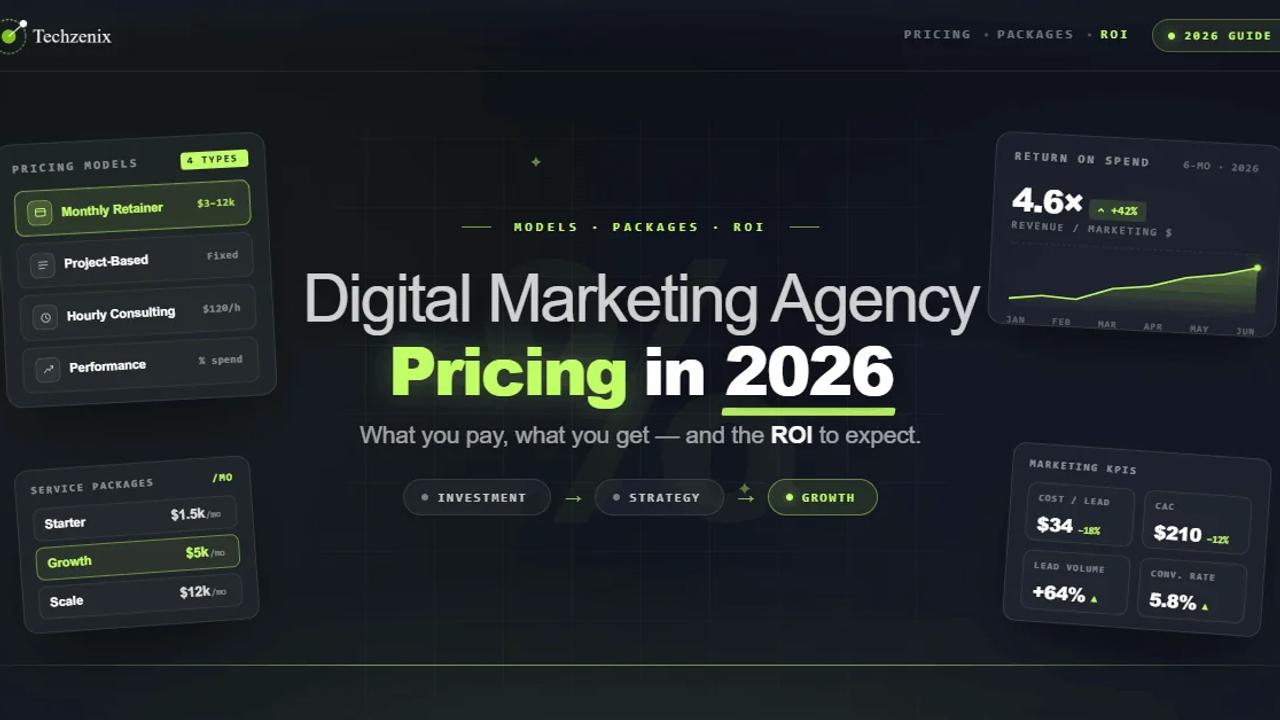
Understanding digital marketing agency pricing in 2026 is essential before choosing the right partner for your business. This guide breaks down the most common pricing models, typical package ranges, and how agencies justify their costs based on services, experience, and ROI. It helps you evaluat
Quick Answer
Digital marketing agency pricing in 2026 ranges from $1,000 to $25,000+ per month for retainers, $75 to $400 per hour for hourly engagements, and $2,500 to $50,000+ for project-based work. Most small businesses spend $2,500 to $7,500 per month, mid-size companies pay $7,500 to $20,000 per month, and enterprises invest $20,000+ monthly. Five common pricing models exist: monthly retainer, hourly, project-based, performance-based, and hybrid. The right model depends on your goals, timeline, and budget predictability needs. AI tools have compressed pricing in 2026, making more agencies competitive at lower price points.
Digital marketing agency pricing is the most confusing part of hiring a marketing partner. One agency quotes $1,500 per month. Another wants $15,000 for the same scope. A third refuses to share any pricing until you book a 60-minute sales call. None of this is accidental, and none of it serves you as the buyer.
This guide pulls back the curtain. It covers the five pricing models agencies actually use, the realistic ranges for each in 2026, what you get inside typical package tiers, specific pricing for small business through enterprise, hidden costs to watch for, and how to know if any of it is worth the money.
By the end of this guide, you will know exactly what you should pay for digital marketing services in 2026 and what to expect in return. If you also want the quick-answer version focused on the total cost question, see our companion post on how much a digital marketing agency costs.
Free 24-Hour Audit
Want a Custom Pricing Quote Instead of Reading Through Everything?
Get a free 24-hour audit and a custom pricing recommendation for your specific business. No commitment, no sales call required.
1. What does digital marketing agency pricing include?
Digital marketing agency pricing covers more than just the hours an agency spends on your account. The monthly fee or project cost typically includes four distinct components.
Important distinction: your ad spend (Google Ads, Meta Ads, LinkedIn Ads) is almost always separate from the agency’s management fee. If an agency quotes you $3,000 per month and you plan to run $5,000 per month in Google Ads, your total monthly investment is $8,000. Always clarify this distinction before signing.
2. The 5 digital marketing agency pricing models
Most agencies use one of five pricing models, sometimes combining two of them. Understanding each model helps you compare quotes accurately and pick the right structure for your situation.
Monthly retainer pricing
The most common pricing model in 2026. You pay a flat monthly fee for a defined scope of work, with predictable costs and continuous optimization. Retainers typically commit for 3 to 12 months, with 30 to 60 day exit clauses standard.
What’s included: Strategy, execution, monthly reporting, regular meetings, tool access. Specific deliverables vary by tier (covered in the packages section below).
Pros: Predictable budgeting. Deep client relationships. Priority support. Ongoing optimization.
Cons: Long-term commitment. You might not use all included services in slow months. Renewal price increases are common.
Hourly rate pricing
You pay only for hours worked. Rates in 2026 range from $75 per hour for junior specialists to $400+ for senior strategists at premium agencies. Most agencies bill in 15-minute increments and require minimum monthly hours.
Best for: One-off audits, strategic consultations, focused single-task projects, or testing an agency before committing to a retainer.
Watch for: Scope creep can drive costs up quickly. A “quick” strategy call can turn into 3 hours of follow-up emails and revisions costing $750+ unexpectedly. Always agree on hour caps before starting work.
Project-based pricing
A fixed fee for specific deliverables. Examples: $5,000 for an SEO audit, $15,000 for a website redesign, $25,000 for a brand rebrand. The agency takes on scope risk in exchange for predictability.
Best for: Clearly defined projects with measurable endpoints. Website builds, single-campaign launches, technical audits, competitive analyses.
Watch for: Scope creep still happens. Get detailed deliverables in writing before signing, with change-order procedures for anything outside the original scope.
Performance-based pricing
The agency’s fee is tied to results, typically a percentage of ad spend (10 to 30 percent) for PPC management, or a revenue share (5 to 15 percent of attributed revenue) for full-funnel work. Less common for SEO because organic results are harder to attribute cleanly.
Best for: PPC and paid media management with clean attribution. Established relationships with clear KPI tracking.
Watch for: Agencies may push for higher ad spend to grow their fee. Attribution debates are common. Reserved for engagements with strong tracking infrastructure.
Hybrid model pricing
Combines a base retainer with a performance bonus. Example: $4,000 per month base plus 10 percent of revenue above a baseline. Increasingly common in 2026 because it aligns agency incentives with client outcomes.
Best for: Mature client-agency relationships where trust is established and KPIs are well-defined.
Watch for: Complexity in contract terms. Make sure both the base and bonus structures are clear, and define what triggers bonus payments precisely.
3. Average digital marketing agency pricing in 2026
According to industry benchmark data from Clutch’s agency pricing surveys and the HubSpot State of Marketing Report 2026, typical digital marketing agency pricing in 2026 breaks down as follows.
By business size
By engagement scope
Engagement Scope Typical Monthly Cost What's Included Single-channel (just SEO or just PPC) $1,500 - $5,000 One service, light reporting Dual-channel $3,500 - $9,000 Two coordinated services, mid-level account team Multi-channel (4+ services) $7,500 - $20,000 Full-service team, dedicated strategist Full-service with paid media $10,000 - $35,000+ Above plus paid media management, designers, CRO
Pricing below $500 per month for digital marketing services in 2026 is almost always automated work, outsourced overseas at scale without quality control, or using risky tactics that will hurt your site within 6 to 12 months. The lower the price, the more likely you will pay for it later in recovery costs.
4. Digital marketing agency pricing packages explained
Most agencies bundle their services into 3 to 4 tiered packages. Understanding what each tier actually includes helps you compare quotes across agencies.
Starter package ($1,000 to $2,500 per month)
- One channel handled (typically SEO basics or social media management)
- 2 to 4 blog posts per month or 8 to 12 social posts per month
- Light monthly reporting (PDF format)
- Email-only support, no weekly meetings
- Junior account team with limited senior oversight
Best fit: Solopreneurs, very small businesses, single-channel needs.
Growth package ($2,500 to $7,500 per month)
- Two to three channels (SEO + content + social or SEO + content + email)
- 4 to 8 blog posts per month
- Monthly strategic review meetings
- Real reporting against KPIs (dashboards or detailed PDFs)
- Mid-level account team with senior strategy oversight
- Light technical SEO and conversion optimization
Best fit: Established SMBs with clear goals, $500K to $5M annual revenue.
Pro / Professional package ($7,500 to $15,000 per month)
- Four or more channels working in coordination
- 8 to 15 blog posts per month plus landing pages and supporting assets
- Active link building or digital PR (10+ quality backlinks per month)
- Conversion rate optimization with formal A/B testing
- Weekly status check-ins plus monthly strategic reviews
- Real-time dashboards instead of PDF reports
- Dedicated strategist plus 3 to 5 specialists
Best fit: Growth-stage companies, $5M to $50M revenue, marketing-led growth strategies.
Enterprise / Custom package ($15,000 to $50,000+ per month)
- Integrated strategy across 5+ channels
- Custom content production at scale (20+ pieces per month)
- Paid media management for $50,000+ in monthly ad spend
- International or multi-region work where applicable
- Custom dashboards and attribution modeling
- Quarterly business reviews with executive-level reporting
- Sometimes embedded staff or onsite work
Best fit: $50M+ revenue companies, multi-brand operations, or organizations entering new markets.
5. Digital marketing agency pricing for mid-size companies
Mid-size companies (typically $5 million to $50 million annual revenue) sit in a specific pricing tier that deserves dedicated coverage because the calculations are different from small business or enterprise.
Typical mid-size company pricing
Most mid-size companies spend $7,500 to $20,000 per month on digital marketing agency services, totaling $90,000 to $240,000 annually. This pricing reflects the scope and stakes of mid-size marketing operations: more channels, larger ad budgets, more complex reporting needs, and higher expectations for ROI.
What mid-size companies should expect at this pricing level
Component What mid-size companies get Account team size Dedicated strategist plus 3 to 6 specialists Channels covered 4 to 7 channels in coordinated execution Content output 12 to 25 pieces per month (blog, landing pages, social) Reporting cadence Weekly tactical, monthly strategic, quarterly business reviews Tooling depth Enterprise tier subscriptions (Ahrefs, SEMrush, HubSpot Hub) Strategic involvement Senior strategists in monthly meetings, CMO-level reviews KPI tracking Real-time dashboards, multi-touch attribution Response time Same-day for urgent, 24 hours standard
Why mid-size pricing is different
Three factors push mid-size pricing above small business rates:
- Scope complexity. Mid-size companies typically run multi-channel campaigns across SEO, paid media, content, email, and social. Each channel needs specialist attention, which raises the agency’s labor cost per account.
- Reporting and accountability requirements. Mid-size companies usually have CMOs, marketing directors, and board-level reporting expectations. Agencies serving this tier invest more in reporting infrastructure and senior strategy time.
- Speed-to-results expectations. Mid-size companies cannot wait 12 months for organic momentum. They typically demand faster gains, which means more aggressive paid media and accelerated content production, both of which add cost.
Mid-size pricing comparison: in-house vs agency
Mid-size companies often weigh whether to build internally or use an agency at this budget level. The math typically favors hybrid models. A senior in-house marketing lead ($150,000 to $180,000 fully loaded) plus an agency retainer of $7,500 to $12,000 per month delivers better results than either pure model for most mid-size companies. For a deeper analysis of this decision, see our comparison of in-house marketing versus agency.
Need Pricing Guidance for Your Mid-Size Company?
Our team specializes in mid-size company marketing operations. Schedule a free 30-minute consultation to discuss your specific situation and budget.
▶ Schedule Free Consultation ◀
6. Pricing breakdown by service type
Different digital marketing services carry different price ranges in 2026. The table below shows realistic ranges for each major service category.
SEO pricing in detail
SEO is one of the broadest pricing categories because the work covers technical audits, content production, link building, local optimization, and international scope. Most SMBs pay $1,500 to $5,000 per month for SEO; growth-stage companies pay $5,000 to $12,000. To see what’s included in dedicated SEO engagements at various tiers, review our SEO services page. For specialized SEO needs, we also offer dedicated local SEO, technical SEO, and eCommerce SEO services.
PPC and paid media pricing in detail
PPC pricing has two components: the agency management fee (typically $1,000 to $7,500 per month, or 10 to 20 percent of ad spend) plus the actual ad spend going to Google, Meta, LinkedIn, or other platforms. A common mistake is budgeting only for the management fee and being shocked when total monthly investment is 3 to 5 times higher. Our PPC management services include clear fee structures and Meta Ads management for Facebook and Instagram campaigns.
Social media marketing pricing in detail
Social media management ranges from $500 per month (one platform, basic posting) to $7,500+ per month (multi-platform, paid campaigns, community management, influencer coordination). Pricing varies most by which platforms are included and how much paid promotion is bundled. See our social media marketing services for platform-specific scope and pricing.
Content writing and link building pricing in detail
Content writing typically runs $0.15 to $1.00 per word for professional agency-produced content, with most B2B content landing at $0.40 to $0.75 per word. A 1,500-word blog post produced by a quality agency costs $600 to $1,100. Link building costs $80 to $400 per quality backlink, with most ethical outreach earning 4 to 8 links per month for SMB scope. See our content writing services and link building services for details.
7. Factors that affect digital marketing agency pricing
Two agencies quoting the same scope can land thousands of dollars apart. Seven factors explain most of the variance.
1. Scope of services
The single biggest pricing driver. Single-channel scope costs 40 to 60 percent less than multi-channel scope. Adding content production, link building, conversion optimization, or analytics depth pushes the retainer up in $1,000 to $3,000 increments per service added.
2. Industry and niche competitiveness
Ranking in competitive niches (legal, finance, B2B SaaS, regulated industries, saturated eCommerce categories) requires more effort than ranking in low-competition niches. Agencies price the effort accordingly. A local services business might pay 30 to 50 percent less than a SaaS company targeting equivalent traffic.
3. Website size and technical complexity
A 30-page brochure site requires less ongoing work than a 5,000-product eCommerce store. Sites with significant technical debt cost more in the first 3 to 6 months because remediation must happen before growth work begins.
4. Agency geographic market
US-based and UK-based agencies typically charge 50 to 100 percent more than equally capable agencies in lower-cost markets for the same scope and quality. This is the offshore arbitrage that drives a lot of pricing variance. For purely digital scope, offshore agencies work well for most buyers.
5. Content and link inclusions
Agencies that include 4 to 8 written articles per month and 3 to 6 quality backlinks per month cost noticeably more than audit-only or strategy-only retainers. Quality backlinks alone cost $80 to $400 each through ethical outreach. Five included links per month means roughly $1,000 of pass-through cost embedded in the retainer.
6. Agency experience and reputation
Premium agencies with 10+ years of track record and recognized industry expertise charge 30 to 100 percent more than newer agencies offering similar scope. The premium pays for lower execution risk and senior strategic input.
7. AI tooling integration
Per the HubSpot State of Marketing Report 2026, 86.4 percent of marketing teams now use AI in some workflow. Agencies that have integrated AI into research, briefing, and first-draft production can deliver more output per billable hour, which compresses the price-quality curve. Agencies still working without AI tooling are quietly losing competitive ground.
8. Hidden costs to watch for in agency pricing
The quoted retainer or project fee is rarely the full cost. Eight common hidden costs catch first-time buyers by surprise.
- Ad spend separate from management fee. The agency’s $3,000 management fee plus your $5,000 ad budget equals $8,000 total monthly investment. Always clarify which is which.
- Tool subscriptions not included. Some agencies pass through tool costs (HubSpot license, premium plugin subscriptions, analytics tools) on top of the retainer. Ask what’s included versus billed separately.
- Onboarding fees. One-time fees of $1,500 to $7,500 are common for setup, audits, and access provisioning in the first month.
- Content asset licensing. Stock photos, custom illustrations, premium templates, and video assets may be billed separately.
- Rush fees. Same-day or weekend turnaround requests often carry a 50 to 100 percent surcharge over standard rates.
- Out-of-scope change orders. Anything outside the original written scope typically requires a change order at the agency’s hourly rate. Define scope tightly upfront.
- Annual price increases. Most retainers include 3 to 8 percent annual price increases at renewal. Confirm this in the contract.
- Termination and offboarding fees. Some agencies charge for the transition work when you exit. Industry standard is that this should be included; push back if charged separately.
Pro Tip
Get the total monthly investment in writing
Before signing, ask the agency to draft an example month showing every line item: management fee, ad spend, tools, content costs, anything else. The total should match what you're prepared to spend each month. If the example is much higher than the quoted retainer, the retainer is misleading you.
9. How to negotiate digital marketing agency pricing
Agency pricing is more negotiable than most buyers realize. Five tactics work consistently to bring quoted prices down 10 to 25 percent without hurting the engagement quality.
Tactic 1: Adjust scope before negotiating price
If the quote is over budget, ask the agency to remove the lowest-priority services rather than discounting the same scope. A leaner scope at the original quality bar usually beats a discounted scope where quality slips. Agencies are also more willing to remove services than reduce hourly rates.
Tactic 2: Commit to a longer engagement for a discount
Most agencies offer 10 to 20 percent discounts for 12-month commitments versus month-to-month engagements. Some offer further discounts for prepayment. If you are confident in the fit, longer commitments save real money.
Tactic 3: Negotiate the onboarding fee
Onboarding fees of $1,500 to $7,500 are often the most negotiable line item. Agencies use them as profit cushions, not as essential cost recovery. Asking for the onboarding to be waived or rolled into the first three months often succeeds.
Tactic 4: Get tooling and pass-through clarity in writing
Hidden tool fees and pass-through costs can add 10 to 20 percent to the quoted retainer. Ask the agency to itemize what’s included and what’s billed separately. Sometimes agencies will absorb tool costs they originally planned to pass through.
Tactic 5: Tell agencies you are comparing 3 quotes
Professional agencies expect to be compared and respond with better proposals when they know it. Hiding the comparison invites complacency. Tell each agency how many others you are evaluating and what your decision timeline is. You don’t need to share competitor names. Use our 20 questions to ask before hiring a digital marketing agency to ensure you are comparing apples to apples.
10. Red flags in digital marketing agency pricing
Certain pricing patterns indicate agencies you should walk away from rather than negotiate with.
- Vague pricing with no benchmarks. Agencies that refuse to share starting prices or rough ranges are usually price-flexing based on what they think you’ll pay.
- Guarantees of specific results. Anyone promising specific Google rankings, traffic numbers, or revenue is misrepresenting capability or using risky tactics. Google’s official guidance warns against this explicitly.
- Long contracts with no exit clause. Industry standard is 30 to 60 day notice within any contract length. Anything less protects the agency, not the relationship.
- Prices far below market. Anything under $500 per month is almost always automated, outsourced overseas at scale, or using risky tactics. The savings on the front end are erased by recovery costs on the back end.
- All-inclusive packages with no menu. Bundled pricing with no breakdown makes it impossible to compare across agencies or identify what’s worth the money.
For a complete checklist of warning signs in agency hiring (beyond pricing alone), see our deep dive on the 12 red flags when hiring a digital marketing agency.
11. ROI: is digital marketing agency pricing worth it?
The honest answer depends on your business situation. Agency spend pays back clearly in some conditions and disappoints in others.
When agency pricing pays back
- Your product or service has working unit economics that marketing can amplify
- You have tracked CAC and LTV so payback is measurable
- You have patience for the channel ramp (SEO needs 6 to 12 months; paid media moves faster)
- Your goals are specific and measurable
- You have internal capacity to act on agency recommendations
When agency pricing disappoints
- The offer or product has poor conversion that marketing cannot fix
- Goals shift every 2 to 3 months
- Internal stakeholders are slow to provide inputs or approvals
- The retainer is too small for the goal (Tier 2 budget, Tier 4 expectations)
- You expect revenue impact in month 2 from SEO work that needs 9 months
Realistic ROI math
A common rule of thumb: agency spend should pay back within 4 to 6 months of customer LTV in B2B, and 2 to 4 months for eCommerce or B2C.
Example: A B2B SaaS company with $4,000 customer LTV and a goal of 10 new customers per month would generate $40,000 in monthly LTV. Spending up to $8,000 per month on the agency (20 percent of attributed LTV) is reasonable. Above that, the math gets tight unless retention or LTV improves.
Payback timelines by channel
12. How Techzenix structures pricing for our clients
Since most readers want to know how this applies to working with us specifically, here’s our pricing structure in plain terms. Like the broader market, we use multiple pricing models depending on the engagement, but we have specific opinions about which model works best for each situation. You can see the full range of services we offer on our services overview page.
Our pricing philosophy
Three principles guide our approach to pricing.
- Transparent ranges, custom quotes. We publish starting prices for each service so you can budget. Final quotes are custom because every engagement is different.
- Scope-first negotiation. If your budget doesn’t match the scope, we adjust scope rather than discounting the same scope. This protects quality.
- No hidden costs. Tools, reporting, meetings, and standard deliverables are included. Ad spend, premium third-party tools, and rush work are clearly itemized when needed.
Our typical pricing tiers
| Tier | Typical Agency Model | Techzenix Approach |
|---|---|---|
| Starter | Single-channel execution with rigid service boundaries | Flexible, goal-driven strategy focused on quick wins and efficiency |
| Growth | Multiple vendors or disconnected channel management | Integrated multi-channel execution under one coordinated team |
| Pro | High overhead management with slower execution cycles | Streamlined execution with faster turnaround and optimization cycles |
| Enterprise | Complex retainers with heavy operational overhead | Dedicated, scalable teams focused on ROI-driven performance and transparency |
Each tier scales based on the specific services included. For pricing on individual services (SEO, PPC management, social media marketing, content writing, link building), see the dedicated service pages or request a custom quote.
Want a Custom Pricing Proposal from Techzenix?
Tell us about your business, goals, and current marketing situation. We'll send back a custom proposal with specific deliverables and pricing within 24 hours.
Conclusion and final thoughts
Digital marketing agency pricing in 2026 is more transparent than it has ever been, but still requires real research to navigate well. The five pricing models (retainer, hourly, project, performance, hybrid) each fit different situations, and the right monthly investment depends on your business size, goals, scope, and timeline.
Three takeaways worth keeping after closing this guide:
- Pricing is a function of scope, not a fixed rate card. If a quote is over budget, adjust scope rather than discounting the same scope. Quality at a lower price point usually beats compromised quality at the original price point.
- Total monthly investment matters more than the headline retainer. Always clarify what’s included versus billed separately, especially ad spend, tool subscriptions, and rush fees.
- ROI depends as much on you as on the agency. Agencies amplify what already works. They cannot fix poor product-market fit, unclear goals, or stakeholder bottlenecks. The clearer your inputs, the more pricing translates to results.
Your next step depends on where you are in the process. If you’re still narrowing down the decision of whether an agency is right at all, start with our pillar guide on how to hire a digital marketing agency. If you have agency proposals in hand and need to compare them, use our checklist on red flags when hiring a digital marketing agency and our list of questions to ask before hiring.
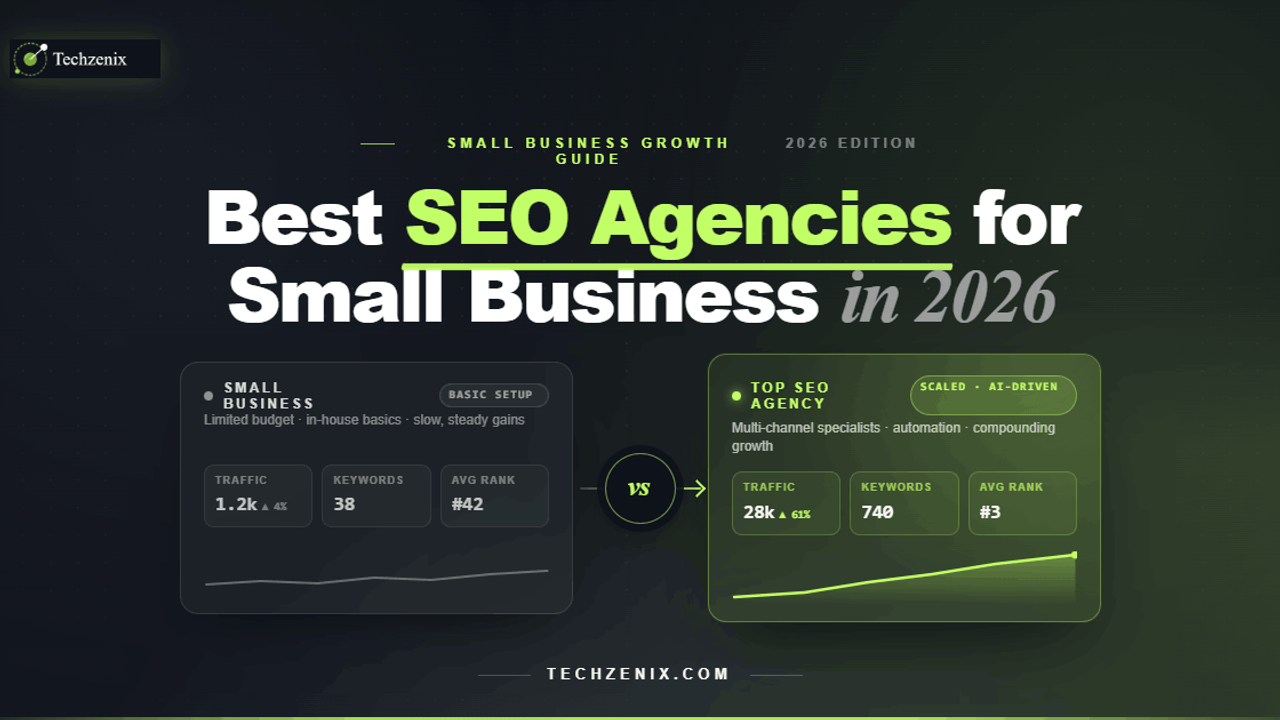
If you want to skip ahead to comparing agencies for your specific industry or business size, see our shortlist of the 10 best SEO agencies for small business in 2026. And if you’re weighing whether to hire an agency at all versus building in-house, our breakdown of in-house marketing versus agency has the full math.
Ready to Invest in Digital Marketing Done Right?
Stop guessing about pricing. Get a free audit, a clear scope recommendation, and a custom pricing proposal from Techzenix within 24 hours. No commitment required.
Frequently asked questions
What is the average digital marketing agency pricing in 2026?
Most small to mid-sized businesses pay $2,500 to $7,500 per month for digital marketing agency services. Growth-stage companies pay $7,500 to $15,000 per month. Mid-size companies typically pay $7,500 to $20,000 per month. Hourly rates range from $75 to $400+. Project-based work runs $2,500 to $50,000+ depending on scope.
Which digital marketing agency pricing model is best?
Monthly retainers are best for ongoing multi-channel work with predictable scope. Hourly rates work best for one-off audits or small tasks. Project pricing fits clearly defined deliverables like website builds or campaign launches. Performance-based pricing works for PPC management with clean attribution. Hybrid pricing fits mature client-agency relationships with established KPIs.
Is digital marketing agency pricing negotiable?
Yes, in two main ways. First, by adjusting scope: removing services you don’t need will reduce the retainer. Second, by commitment length: most agencies offer a 10 to 20 percent discount for 12-month commitments compared to month-to-month engagements. Onboarding fees are also typically negotiable.
What's included in digital marketing agency pricing packages?
Typical packages include strategy, execution across agreed channels, monthly reporting, meetings, and tool access. Specific deliverables vary by tier. Starter packages ($1,000-$2,500/mo) cover one channel. Growth packages ($2,500-$7,500/mo) cover 2-3 channels. Pro packages ($7,500-$15,000/mo) cover multi-channel work. Enterprise packages ($15,000+/mo) include custom scope.
How much should mid-size companies pay for digital marketing?
Mid-size companies ($5M to $50M annual revenue) typically pay $7,500 to $20,000 per month, totaling $90,000 to $240,000 annually. This level supports multi-channel execution, dedicated strategists, and the reporting depth mid-size companies need.
What hidden costs should I watch for?
Eight common hidden costs: ad spend separate from management fees, tool subscriptions not included, onboarding fees, content asset licensing, rush fees, out-of-scope change orders, annual price increases, and termination fees. Get total monthly investment in writing before signing.
How long does it take to see ROI from a digital marketing agency?
Paid media shows results in 2 to 12 weeks. SEO and content show material results at 6 to 9 months. Email and conversion optimization show results at 2 to 6 months. Per Google’s own guidance on hiring SEO, SEO needs four months to a year to show meaningful benefits.
Are cheaper digital marketing agencies worth it?
Cheaper agencies (under $1,500 per month) can work for very small businesses with single-channel local scope. Below $500 per month is almost always automated work, low-quality outsourced execution, or risky tactics that hurt your site long term. The savings rarely justify the recovery costs later.
What is the difference between management fees and ad spend?
The agency’s management fee pays for their time and expertise managing your campaigns. Ad spend pays Google, Meta, LinkedIn, or other platforms to run the ads themselves. A $3,000 monthly management fee plus $5,000 monthly ad budget equals $8,000 total monthly investment. Always clarify which is which before signing.
Can I get a digital marketing agency to share pricing upfront?
Yes. Professional agencies share at least starting prices or tier ranges before sending custom proposals. Agencies that refuse to share any pricing benchmarks until you book a sales call are usually price-flexing based on what they think you’ll pay. Press for ranges; if they refuse, walk away.
Do digital marketing agencies offer bundled service discounts?
Yes. Most agencies offer 10 to 20 percent discounts when you bundle multiple services compared to buying each service separately. Bundle discounts only make sense if you genuinely need all the bundled services; otherwise, the discount is on services you don’t need.
How does AI affect digital marketing agency pricing in 2026?
AI tools have compressed the price-quality curve. Agencies that have integrated AI into research, briefing, and first-draft production deliver more output per billable hour. This lets them either lower prices or include more in the retainer. Agencies still working without AI tooling are competing at a disadvantage.

Ali Hamza is an SEO specialist and digital marketer with 7+ years of experience in SEO, content strategy, WordPress, and online growth marketing. He shares practical insights and industry-based strategies focused on improving search visibility, user experience, and long-term organic growth.