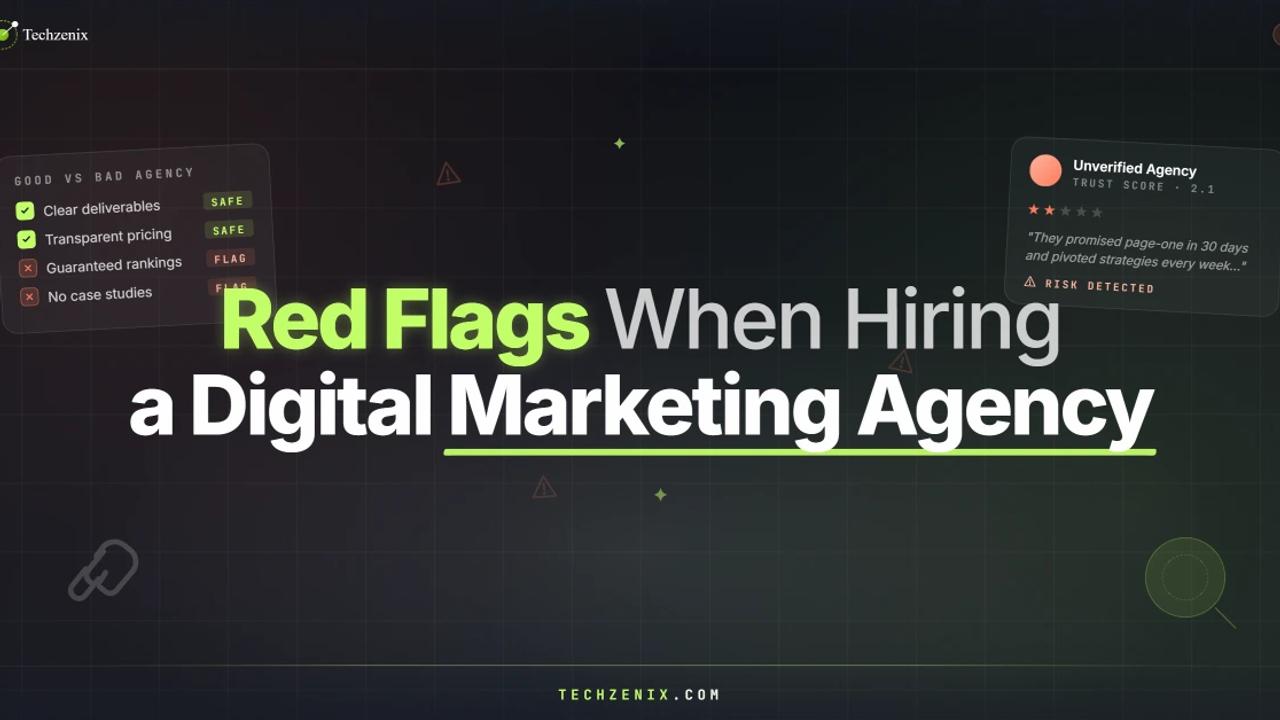
Avoid costly mistakes when choosing a marketing partner. This guide covers the biggest red flags to watch for when hiring a digital marketing agency, from unrealistic promises and vague reporting to hidden fees and poor communication, helping you make a smarter, more informed decision.
Quick Answer
The 12 most reliable red flags when hiring a digital marketing agency in 2026 are: ranking or revenue guarantees, vague pricing, generic template proposals, sales reps who dominate discovery calls, missing case studies, no sample reports, outsourced strategy work, tactic-first thinking, restrictive contracts, poor agency visibility, lack of AI search awareness, and refusal to identify the account team.
Any single top-tier red flag is reason enough to walk away. Two or more lower-tier red flags usually indicate a disappointing engagement.
Every buyer who has been burned by a marketing agency once becomes much better at spotting the next bad one. The pattern recognition takes a costly engagement to develop. This post is the shortcut: 12 red flags that experienced marketing buyers learn to watch for, organized by severity so you know which ones are immediate disqualifiers and which ones are caution signs that need follow-up questions.
Some of these red flags are obvious once you see them named. Others are subtle and slip past most first-time buyers. By the end of this post, you will have a written checklist to apply during your next agency search.
This post is part of our series on hiring a digital marketing agency. For the full hiring framework that prevents most of these problems before they start, see our pillar guide: how to hire a digital marketing agency.
What this guide covers
- 4 disqualifying red flags (immediate walk-away signals)
- 4 serious warning signs (further investigation required)
- 4 caution signs (need explanation before signing)
- How to spot these red flags during the sales process
- What to do if you have already signed with an agency that shows these signs
How to use this list
Print this checklist and bring it to every agency discovery call. As you talk to each agency, mark which red flags appear. A single tier-1 red flag is enough to disqualify. Two or more tier-2 or tier-3 flags combined usually indicates the same problem from different angles.
Trust the pattern, not the individual signal. Agencies are not bad because of one isolated behavior; they are bad because the same underlying problem (lack of capability, lack of process, or lack of integrity) shows up in multiple ways.
Tier 1: Disqualifying red flags (walk away immediately)
These four red flags do not require further investigation. Any one of them is enough to end the conversation.
1. Ranking or revenue guarantees
The signal: An agency promises “first page on Google in 90 days” or “guaranteed 200 percent ROI in six months” without any conditions.
Why it matters: No agency controls Google’s ranking algorithm or your customers’ purchasing decisions. Google’s own quality guidelines explicitly warn against working with anyone who guarantees specific rankings. Agencies that promise outcomes outside their control are either lying about capability or using black-hat tactics that will hurt your site within 6 to 12 months.
What to do instead: Trust agencies that commit to process (specific deliverables, hours, methodology) and offer KPI targets with stated confidence levels. “We commit to publishing 8 posts per month and earning 5 quality backlinks per month” is honest. “We guarantee 200 percent more traffic in 90 days” is not.
2. Vague pricing with no benchmarks
The signal: When you ask about pricing, the agency says “it depends on your needs” and provides no ranges, no tiers, and no benchmarks even after you have shared your situation.
Why it matters: Agencies that operate transparently can share at least starting prices and rough ranges for typical scopes. Agencies that stay vague are usually price-flexing based on what they think you will pay, which sets up an unequal negotiation from day one. The opacity also tends to continue into reporting and accountability after you sign.
What to do instead: Press for ranges. “What would a typical SMB client pay you per month?” is a fair question, and a serious agency will answer it. Our guide to agency pricing covers the realistic 2026 ranges so you have benchmarks to compare against.
3. Generic template proposals
The signal: After your discovery call, the proposal you receive could have been sent to any company with the company name changed. It does not reference specifics from your conversation, your industry, or your goals.
Why it matters: If the agency cannot customize a proposal during the sales process when they are trying to win your business, they will not customize the work after you have signed. The proposal is a preview of how seriously they will take your account.
What to do instead: A real proposal should reference at least 3 specific things you mentioned in the discovery call. If it does not, ask the agency to revise. Their willingness to revise tells you everything.
4. Sales rep does 70 percent of the talking on the discovery call
The signal: The discovery call is supposed to be discovery. Instead, the sales representative walks you through the agency’s case studies, methodology decks, and pricing menu while asking you minimal questions about your situation.
Why it matters: Agencies that pitch first and listen second tend to deliver generic strategies because they never understood the specifics of your situation. The discovery call sets the pattern for the whole relationship. If they cannot listen to you when they want your business, they will not listen to you after they have it.
What to do instead: End the call early if it goes pitch-heavy. There are too many capable agencies in the market to spend time with one that does not respect the discovery process.
Tier 2: Serious warning signs (require investigation)
These red flags warrant a direct question to the agency. The answer may resolve the concern, or it may confirm it. Either way, you cannot ignore the signal.
5. Missing or anonymous case studies
The signal: The agency website says “we have helped over 100 brands grow” but the case studies section is empty, or every case study uses anonymous descriptions like “a leading SaaS company in the fintech space.”
Why it matters: Genuine NDAs do exist, especially for enterprise work. But an agency with 100+ clients should have at least 5 to 10 case studies with named clients, real numbers, and verifiable results. If they do not, the work either is not as impressive as claimed, or the case studies themselves are not real.
What to do instead: Ask: “Can I speak directly to two of your current clients before signing?” A confident agency will arrange this within a few days. An agency that stalls or refuses is signaling something.
6. Cannot show a real sample report
The signal: When you ask to see what monthly reporting looks like, the agency shows you a marketing-deck mockup rather than an actual anonymized report from a real account.
Why it matters: Every agency that does real client work has real reports. If they cannot share one (even anonymized), they probably are not sending real reports to clients either. Reporting is one of the first places under-delivery shows up, so this is a leading indicator of the entire engagement.
What to do instead: Specifically ask: “Can you send me an anonymized version of the report you sent your largest client last month?” The answer separates agencies that report from agencies that pretend to.
7. Strategy work is outsourced
The signal: Direct question: “Is any of the work outsourced?” The honest answer should clarify which roles are in-house and which are contracted. The red flag is when strategy and account leadership themselves are outsourced rather than execution roles like design or content.
Why it matters: Execution roles being subcontracted is normal and often efficient. Strategy being outsourced means the agency is essentially a middleman selling someone else’s thinking at a markup. You can hire that strategic person directly for less.
What to do instead: Ask directly: “Who specifically will own strategy for our account, and are they your employee?” Look at that person on LinkedIn. If they list themselves as employed by the agency, you are probably fine.
8. Leads with tactics before understanding goals
The signal: Before learning much about your business, the agency tells you “you need more backlinks” or “you should be running Meta ads” or “your website needs a redesign.”
Why it matters: Tactical-first agencies tend to deliver tactical-first work. They will execute things without questioning whether those things are the right things. This is how clients end up paying for 50 blog posts that nobody reads, or 20 backlinks that point at a page nobody converts on.
What to do instead: Reward agencies that ask clarifying questions before suggesting solutions. A good first conversation should include the agency asking what you are trying to achieve, who your customer is, and what has already been tried, before any recommendation appears.
Tier 3: Caution signs (ask for explanation)
These four red flags often have legitimate explanations. Ask the question and judge the answer. If the explanation is reasonable, proceed cautiously. If the explanation feels evasive, treat it as a higher-tier flag.
9. Long-term contracts with no exit clause
The signal: The contract requires a 12-month minimum commitment with no exit clause, or with an exit clause that requires you to forfeit a significant payment.
Why it matters: Industry standard is a 30 to 60 day notice clause. Agencies that lock you in without a real exit are protecting themselves from clients leaving when the work disappoints. Confident agencies do not need long lock-ins because their results retain clients voluntarily.
What to do instead: Negotiate the exit clause before signing. Most agencies will agree to 30 to 60 day notice if you push back. If they refuse entirely, that is your answer.
10. Their own marketing is poor or invisible
The signal: The agency has no recent blog content, no active social media presence, a slow or poorly designed website, or no organic search visibility for the keywords they claim to help clients rank for.
Why it matters: If they cannot do marketing for themselves, they probably cannot do it well for you either. Agencies typically prioritize client work over their own marketing, but “poor” and “invisible” are different from “deprioritized.” An agency that has not published anything in 18 months is not deprioritizing; they are coasting.
What to do instead: Look at their LinkedIn, blog, and search rankings before the call. If they cannot demonstrate their craft on their own asset, ask why. Sometimes the answer is reasonable (they are at capacity). Sometimes the answer reveals deeper capability gaps.
11. No awareness of AI search visibility
The signal: When you ask how the agency thinks about AI search engines (ChatGPT, Claude, Perplexity, Google AI Overviews), they dismiss the question with “that’s not really a thing yet” or “we’ll figure it out when it matters.”
Why it matters: In 2026, AI search engines drive a meaningful share of decision-maker traffic in many B2B categories. An agency that is not thinking about Generative Engine Optimization, AI Overview citations, and llms.txt files is operating with 2022’s playbook. They will deliver 2022 results.
What to do instead: Look for agencies that can speak fluently about how AI search differs from traditional search, what their process is for measuring AI engine citations, and how they adjust content for extractability in AI Overviews.
12. Refuses to name the account team
The signal: When you ask “who will actually work on our account?” the agency gives vague answers like “a dedicated team will be assigned” without naming specific people you can verify on LinkedIn.
Why it matters: Agencies that sell with senior people and deliver with juniors are using a classic bait-and-switch. The fix is to insist on knowing the specific account team before signing, and to write that team’s continuity into the contract.
What to do instead: Ask: “Who specifically will be the strategist, the account manager, and the channel specialists for our account?” Then look at each person on LinkedIn. If the agency refuses or stalls, add an account-team-named-in-contract clause to your negotiation.
How to spot these red flags during the sales process
Three habits surface most red flags before they cost you money.
Habit 1: Send the same brief to every agency
Before the first call, write a one-page brief covering your business, your goals, your budget range, and your timeline. Send it to every agency you are considering. Agencies that customize their response are signaling capability. Agencies that reply with boilerplate are signaling something else.
Habit 2: Ask the same questions to every agency
Run the same script in every discovery call. Identical questions across agencies make comparison easier and surface inconsistencies. Our companion post on questions to ask before hiring a digital marketing agency has the full vetting checklist.
Habit 3: Look at what they do, not what they say
Agencies will say anything in a sales call. What they actually do, you can verify externally. Look at their blog, their LinkedIn team page, their backlink profile, their search rankings, their own conversion-optimized landing pages. If the agency’s external evidence does not match their pitch, trust the evidence.
What to do if you have already signed with an agency showing these red flags
If you are reading this post mid-engagement and recognizing your current agency in the list, there are three things to do, in order.
Step 1: Document the specific concerns
Write down the red flags you have observed with dates and examples. “Generic reporting in months 2 and 3, no response to escalation email on date X, sales rep replaced by junior account manager without notice.” Documentation matters if you eventually exit and want to recover anything.
Step 2: Have a direct conversation
Schedule a call with the agency’s senior leadership (not your account manager) and walk through the specific concerns. Give them 30 to 60 days to demonstrate improvement against agreed metrics. Some agency-client relationships recover from a frank conversation. Most do not, but the conversation is worth having before exit.
Step 3: Prepare a clean exit
Re-read your contract for the exit clause and notice period. Get all account access, data, content, and creative assets transferred to you in writing. Pay through the notice period even if the relationship has gone bad; burning bridges in your industry rarely pays off. Our post on how to switch marketing agencies covers the full transition playbook.
Need a Second Opinion Before You Sign?
If you are considering a digital marketing agency or have already received a proposal we offer a free proposal review.
Our team will review the proposal, identify potential concerns using the checklist above, and provide additional questions you should ask before signing. No obligation and no commitment required.
Request Your Free Review → Email: info@techzenix.com
Frequently asked questions
What are the biggest red flags when hiring a digital marketing agency?
The top tier of red flags includes ranking or revenue guarantees, vague pricing with no benchmarks, generic template proposals that do not reference your situation, and sales reps who dominate the discovery call. Any one of these is enough to walk away. Lower-tier signs like missing case studies, no sample reports, outsourced strategy, and tactical-before-strategic thinking are serious warnings that require direct follow-up questions.
Should I always avoid an agency that guarantees rankings?
Yes. Google’s own quality guidelines warn against working with anyone who guarantees specific rankings because no agency controls the algorithm. Agencies that promise outcomes outside their control are either misrepresenting their capability or using risky tactics that will hurt your site later. The exception is committing to process (specific deliverables, hours, methodology), which is reasonable. Promising specific rankings is not.
How can I verify an agency's case studies are real?
Ask to speak directly with two current clients before signing. A confident agency will arrange this within 3 to 5 business days. You can also cross-check named clients on the agency’s case studies against the clients’ own websites, LinkedIn, or public press for consistency. Agencies that stall or refuse to connect you with references are signaling that the case studies may not be what they appear.
Is it a red flag if an agency outsources work?
It depends on what is outsourced. Execution work like graphic design, content writing, or development being subcontracted is normal and often efficient. Strategy and account leadership being outsourced is the red flag. If the people thinking about your business are not employed by the agency, you are paying a markup for a freelancer with extra steps.
When should I switch from agency to in-house?
Consider the switch when your monthly agency spend exceeds $15,000 per month, your scope has narrowed to 1 to 2 channels you understand deeply, you have predictable revenue to support full-time payroll, and you have the management bandwidth to hire and develop a team. A common pattern is moving the channel you understand best in-house while keeping the agency for everything else.
What should I do if I notice red flags after signing the contract?
Document specific concerns with dates and examples. Have a direct conversation with the agency’s senior leadership, giving them 30 to 60 days to demonstrate improvement against agreed metrics. If the situation does not improve, re-read your contract for the exit clause and notice period, then transition cleanly with all account access and assets transferred to you in writing.
Are long-term contracts always a bad idea?
Not always, but long-term contracts without a reasonable exit clause are. Industry standard is a 30 to 60 day notice clause within any contract length. Some agencies offer pricing discounts for 12-month commitments, which can be fair if the exit clause remains workable. The red flag is when the contract length combines with no exit pathway, because that protects the agency rather than the relationship.
How do I know if a sales rep is misleading me?
Three checks: ask for everything in writing after the call (verbal promises do not survive). Ask the same questions to multiple agencies and compare answers. Verify externally whatever the sales rep claims; if they say they have a HubSpot Platinum partner badge, check the HubSpot directory. Misleading sales reps often hold up under one round of questioning but fall apart under cross-referenced verification.
What is the most subtle red flag that buyers usually miss?
Agencies that are invisible in their own marketing. Most buyers do not check whether the agency they are hiring practices what they preach. An agency with no recent blog content, no active social presence, no organic visibility for the keywords they claim to help clients rank for, and no SEO-optimized landing pages of their own is signaling something. It is one of the few red flags you can verify completely before the first conversation.
Should I share my red flag findings with the agency?
Yes, in two scenarios. Before signing: bringing up specific concerns gives the agency a chance to address them, and how they respond is itself a signal. After signing: documented concerns shared in writing protect you legally and give the agency an opportunity to course-correct before exit. The exception is the tier-1 red flags during the sales process; if those appear, end the conversation rather than negotiate.

Ali Hamza is an SEO specialist and digital marketer with 7+ years of experience in SEO, content strategy, WordPress, and online growth marketing. He shares practical insights and industry-based strategies focused on improving search visibility, user experience, and long-term organic growth.