Learn how to choose the right digital marketing agency for your business with practical tips on evaluating expertise, pricing, communication, and proven results to ensure long-term success.
QUICK ANSWER
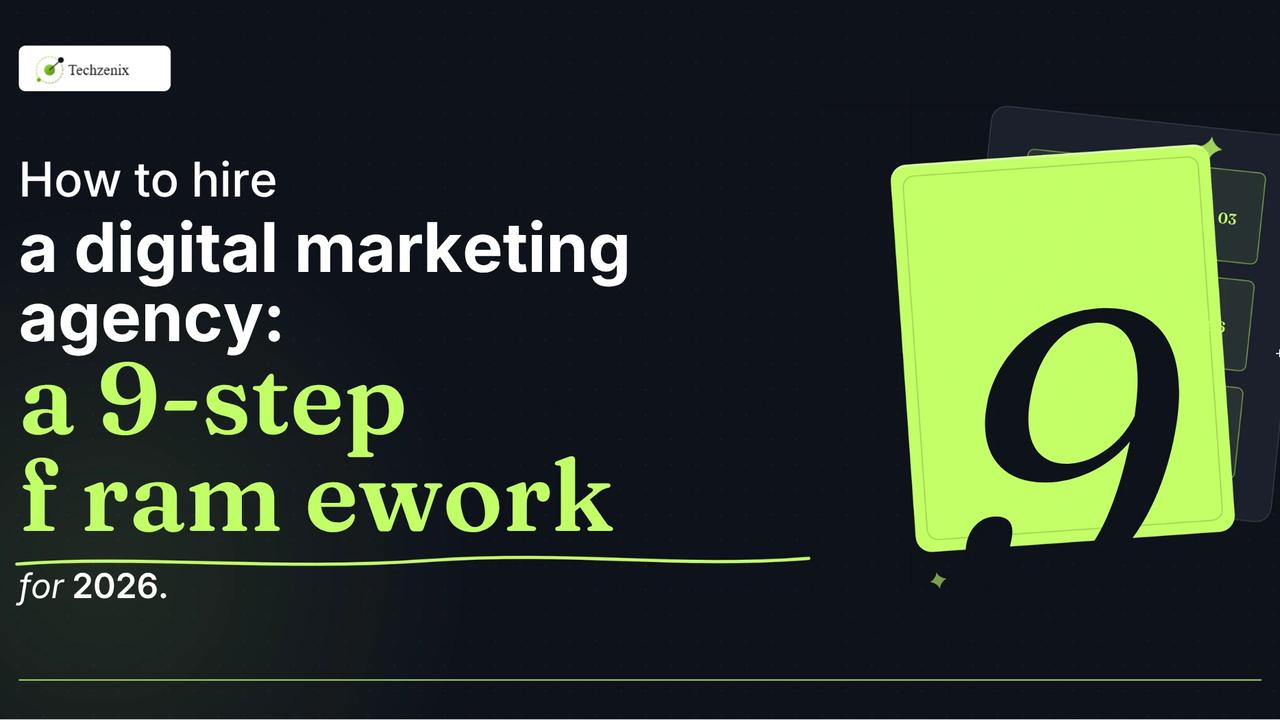
Hiring a digital marketing agency in 2026 is a 9-step process that takes 4 to 8 weeks if done right. Audit your current marketing, set 3 measurable goals, get leadership buy-in, define a real budget, build a shortlist of 5 to 8 agencies, vet each one against a written scorecard, run discovery calls, compare proposals side by side, then negotiate scope and exit terms before signing. Most hiring failures trace back to skipping the first three steps, not to picking the wrong agency.
Most guides to hiring a digital marketing agency are written by agencies. This one is written for the buyer.
If you have ever signed a year-long retainer that delivered three blog posts and a vanity report, or watched a sales rep on a discovery call do 80 percent of the talking, you know the cost of getting this hire wrong. The good news is that the process for getting it right is not complicated. It is a sequence of steps. Most buyers skip the early ones because they feel slow, and then spend six months wondering why the agency relationship is not working.
Below is the full 9-step framework. Each step has a clear input, a clear output, and a typical time investment. Use it once, and you will never approach this hire the same way again.
What this guide covers
This is the pillar post for our entire series on hiring an agency. It explains the process from start to signature. For deeper coverage of specific decisions (pricing, vetting questions, red flags, agency versus freelance), you will find links to dedicated posts throughout. The full series is listed at the bottom.
Why this hire is harder than it looks
Three reasons buyers consistently get it wrong.
First, the market is opaque. There is no Glassdoor for agencies. Reviews on third-party directories are often paid placements. Case studies on agency websites are curated, sometimes invented. The buyer has to do the diligence work themselves.
Second, the deliverable is invisible. When you hire a builder, you can see the building. When you hire a marketing agency, you might wait 6 to 12 months before you can confidently say whether it worked. By then you have spent five or six figures.
Third, the field is changing fast. AI search engines, Generative Engine Optimization, and shifting attribution models mean that an agency which was excellent in 2022 may be coasting on outdated playbooks today. Vetting for 2026 needs different criteria than vetting for 2020.
The framework that follows controls for all three.
The 9-step framework to hire a digital marketing agency
Run the steps in order. Skipping ahead is the most common reason engagements fail.
Step 1: Audit your current marketing state
Time: 3 to 5 days. Output: A two-page document covering what is true today.
Before you talk to a single agency, write down the facts. Not the version of the facts you want to present. The actual numbers.
- Monthly traffic by channel (organic, paid, social, direct, referral, email)
- Monthly leads by source
- Customer acquisition cost (CAC) by channel, if you can calculate it
- Lifetime value of a customer (LTV)
- Current monthly marketing spend, broken down by channel and tool
- What is working internally and what is not
- Which skills exist in your team and which gaps you want the agency to fill
If you cannot answer most of these questions, that is useful information. It tells you the first phase of the engagement will be measurement and discovery, not execution. Be honest about it. Agencies that hear vague answers tend to write vague proposals.
Step 2: Define what success looks like in 12 months
Time: 1 to 2 days. Output: Three measurable goals with timelines.
Pick three goals. Quantify each one. Examples that work:
- Grow organic sessions from 4,000 to 25,000 per month within 12 months
- Reduce blended CAC from $90 to $55 within 9 months
- Generate 60 marketing-qualified leads per month from organic and paid by month 6
If you cannot quantify a goal, you cannot evaluate the agency against it. Vague goals like “we want to grow” or “we want better leads” guarantee an unhappy review meeting six months in.
Step 3: Get leadership buy-in
Time: 1 meeting (30 to 45 minutes). Output: Explicit written sign-off from your CEO, CFO, and sales lead.
This is the step nobody writes about because it sounds bureaucratic. It is the step that saves you from rework.
Walk your leadership team through the audit results, the three goals, the budget range you are considering, the expected timeline, and what success will look like at months 3, 6, and 12. Get a clear yes before you start the agency search.
Otherwise you will spend six weeks selecting an agency, present the proposal, and watch your CEO say, “Actually, can they focus more on enterprise sales enablement?” Now you are starting over, the agency is annoyed, and you have lost momentum.
Step 4: Set your real budget
Time: Half a day. Output: A monthly retainer range plus a 6-month commitment minimum.
Match the budget to the goals. If your goals require multi-channel execution and your budget covers a single freelancer, the math will not work. You cannot get enterprise outputs from boutique inputs. Anyone who tells you otherwise is selling a story.
For a quick orientation: in 2026, mid-market digital marketing agencies in the US and UK typically charge $2,500 to $9,000 per month for SMB scope, and $10,000 to $25,000 for growth-stage scope. Offshore agencies offer 50 to 70 percent cost arbitrage for comparable quality. For a detailed pricing breakdown by service type, see our companion post on digital marketing agency pricing models.
A useful rule: budget at least 6 months of retainer up front before judging results. If you cannot commit 6 months, you are not ready for an agency. Hire a freelancer for a specific project instead.
Step 5: Build a shortlist of 5 to 8 agencies
Time: 3 to 5 days. Output: A spreadsheet with 5 to 8 candidate agencies and the source of each.
Build the list from these sources, in order of signal quality:
- Direct referrals from people whose marketing you respect. Highest hit rate by far.
- LinkedIn search for agencies in your niche; check their team pages and case studies.
- Reviews on Clutch, GoodFirms, DesignRush, or UpCity. Filter by industry match, not just star rating.
- Google searches for “[your industry] marketing agency” or “[your niche] SEO agency.” The agencies ranking organically for these terms are demonstrating they can do the work.
- Industry publications and podcasts. Agencies that publish thoughtful content tend to deliver thoughtful work.
Eliminate any agency where you cannot find named team members on LinkedIn, where the website has no real case studies, or where the contact form takes more than 4 days to reply. These are leading indicators of how they will handle you as a client.
Step 6: Vet each shortlisted agency against a written scorecard
Time: 3 to 5 days, mostly desk research. Output: Scored shortlist; narrow down to top 3 to 4.
Score every agency on the same 10 dimensions before any sales conversations. Doing this writing first, talking second, eliminates the natural bias toward the smoothest salesperson.
For specific warning signs to watch for during this vetting stage, see our deep dive on red flags when hiring a digital marketing agency.
Step 7: Run discovery calls with your top 3 to 4
Time: One 45-minute call per agency. Output: Notes per agency; further narrowing to top 2 to 3.
Before each call, send the agency your audit summary and three goals. This filters out the agencies who just want to pitch and rewards the ones who want to understand.
The call should be roughly 30 percent you talking about your business, 50 percent them asking clarifying questions, and 20 percent them sharing initial thinking. If the agency spends 60 percent of the call walking through their case study deck, that tells you what the relationship will feel like later.
Use a consistent question list for every agency. We have a complete vetting framework in our post on questions to ask before hiring a digital marketing agency. The questions cover the work, the team, the process, the contract, and the agency itself. Print it before each call.
Step 8: Compare written proposals side by side
Time: 5 to 10 business days for agencies to deliver, 1 day for you to compare. Output: A side-by-side comparison; selected winner.
Request a written proposal from your top 2 to 3 finalists. A real proposal includes:
- A summary of what they understood about your situation (proves they listened)
- Their recommended approach and reasoning (not just a deliverables list)
- Specific monthly deliverables and effort estimates
- Pricing and contract terms in writing
- Named team members who will work on your account
- Reporting and communication structure
- Expected milestones at months 3, 6, and 12
If a proposal reads like boilerplate that could fit any client, that is your answer. Real proposals reference specifics from your discovery call. For a structured way to compare proposals across multiple agencies, see how to evaluate an SEO agency proposal. The same logic applies for digital marketing proposals more broadly.
If you prefer to formalize the proposal request with a written brief, our guide to writing a marketing agency RFP includes a free template.
Step 9: Negotiate scope, contract terms, and sign
Time: 3 to 7 days. Output: A signed contract with clear scope, KPIs, and exit terms.
Before signing, get clarity in writing on:
- Initial contract length and renewal terms
- Exit clause (30 to 60 day notice is industry standard)
- Who owns the content, accounts, and assets created (you should, always)
- What happens if KPIs are missed (no agency should guarantee rankings, but they should guarantee process)
- Payment terms and currency
- Indemnification and liability caps
- Pause clauses if you have a seasonal business or a possible cash crunch
If the agency pushes back unreasonably on any of these, that is information. The contract you sign on day one is the contract you live with on the bad days.
| Quick-decision check Stuck deciding between agency, freelancer, and in-house hire instead? That is a separate question worth its own answer. See our breakdowns of in-house versus agency and freelance versus agency for the financial and strategic math on each option. |
How long does the hiring process actually take?
Run end to end, the framework above takes 4 to 8 weeks. The fastest scenario assumes leadership buy-in already exists and you have strong referrals. The longest scenario assumes you start from a cold list and need to build internal alignment in parallel.
Buyers who try to compress this below 3 weeks are usually skipping steps 1, 2, and 3. That is the same set of buyers who write angry posts about agency engagements 8 months later.
What you should have ready before your first agency call
If you walk into a discovery call without these in hand, the agency will spend most of the call asking you questions you should have already answered for yourself. That is wasted time.
- Your two-page state-of-marketing document from Step 1
- Your three measurable 12-month goals from Step 2
- Written sign-off from leadership on the budget range
- A clear picture of which marketing functions will stay in-house and which will move to the agency
- Access logistics: who at your end will be the day-to-day contact, who has the authority to sign, who needs to be CC’d
- A target timeline for kickoff (a real start date, not “as soon as possible”)
Agencies that take you seriously when you bring these to a first call are the same agencies that will take you seriously six months in. Agencies that wave them off and want to “just have a conversation” are usually the ones who later send vague reports.
After you sign: what to expect in the first 90 days
Hiring is the start, not the finish. The first 90 days set the tone for the entire engagement.
Days 1 to 14
Onboarding, access requests, brand and asset reviews, kickoff meeting with the full account team. You should meet every person who will work on your account in this window, not just the salesperson who pitched you.
Days 15 to 30
Discovery deliverables: technical audit, keyword and content gap analysis, paid media audit if relevant, a 90-day tactical roadmap, agreed KPI baselines.
Days 31 to 60
First execution wave. New content shipped, tracking and analytics verified, paid campaigns launched if applicable, first monthly report delivered with baselines clearly stated.
Days 61 to 90
Iteration based on early data. Strategy adjustments where needed. Outreach campaigns ramped if link building is in scope. A formal quarterly review meeting closes the period.
By day 90 you should see early movement on at least one leading metric (impressions, rankings, ad performance), even if revenue impact is still months away. If you see nothing at all by day 90, that is the moment to raise hard questions.
The most common mistakes buyers make
Across the cluster of supporting posts in this series, we cover specific tactics for vetting questions, red flags, and contract terms. At the framework level, five mistakes account for most failed engagements.
- Skipping Step 1 (audit). Going into agency conversations without a clear picture of your current state forces the agency to guess what you need, which leads to generic proposals.
- Skipping Step 2 (goals). No measurable goals means no objective way to evaluate performance, which means the relationship lives or dies on vibes.
- Skipping Step 3 (leadership buy-in). The CEO surprise at proposal time is the most common cause of restarted searches.
- Falling for the best salesperson instead of the best fit. The agency that runs the most polished pitch is not always the agency that delivers the best work.
- Signing without an exit clause. A 12-month no-exit contract protects the agency, not you. Industry standard is 30 to 60 days notice.
If you are also weighing whether an agency is the right model in the first place, two adjacent decisions are worth thinking through carefully: in-house marketing team versus agency, and hiring a freelancer versus an agency. Both posts include the actual math at different budget levels.
Where to go from here
If you have read this far, you have done more diligence than most buyers. The next step is the work in Steps 1, 2, and 3 above. Skip those and even the best agency relationship will struggle.
Frequently asked questions
How long does it take to hire a digital marketing agency?
End to end, 4 to 8 weeks. The fastest scenarios assume leadership buy-in is already aligned and you start from strong referrals. The longest scenarios involve building internal alignment in parallel with agency search. Compressing the process below 3 weeks usually means skipping the preparation steps, which costs more later than it saves now.
Can I run this hiring process myself, or do I need a consultant?
Most companies can run it in-house using a framework like this one. Bringing in a paid consultant or fractional CMO makes sense in two cases: when the company has never hired a marketing agency before and there is significant budget on the line, or when the leadership team disagrees about the scope and an outside voice is needed to mediate. Outside of those cases, the process is well within reach for any marketing manager or founder willing to do the preparation work.
How many agencies should I shortlist?
Five to eight at the start of vetting, narrowing to three or four for discovery calls, and two or three for written proposals. Fewer than five gives you too little signal. More than eight wastes time on agencies you will eliminate anyway. By the proposal stage, two or three is plenty.
Should I tell agencies I am comparing them with others?
Yes. Professional agencies expect this and respond with better proposals when they know they are being compared. Hiding the comparison invites complacency. Be transparent: tell them how many other agencies are in the consideration set (not the names), and what your decision timeline looks like.
What if I get through the process and do not like any of the proposals?
That usually means one of three things: your brief was unclear and every agency interpreted it differently, your budget did not match your goals and every agency had to compromise, or the shortlist was wrong and you need to widen the search. Diagnose which one, then go back to that step. Do not pick the least-bad option because you are tired of the process.
Can I run a trial period with an agency before signing a long contract?
Some agencies offer 30 to 90 day pilot engagements; others do not. The tradeoff is that trial periods often skip the strategy phase and jump to tactical execution, which is rarely a fair test of what the agency can do. A better alternative is a short paid audit or strategy sprint (1 to 4 weeks) as a precursor to the retainer. That tests strategic thinking without forcing the agency to compress real work into too short a window.
Should I use a formal RFP process or skip it?
RFPs work well when the project is well-defined (a website rebuild, a specific campaign, a one-time audit) and when you have at least four or five capable agencies in the running. They work poorly when the scope is ambiguous and the search is more about finding a long-term strategic partner. For ongoing retainer engagements, the framework above (discovery call plus written proposal) usually produces better outcomes than a heavyweight RFP.
How do I know if an agency is actually doing the work after we sign?
Three signals to ask for every month: a list of specific outputs (URLs updated, campaigns launched, links earned, content shipped), a metrics dashboard against the agreed KPIs, and a recorded video walkthrough of the strategic thinking. If you get vague summaries instead of specific outputs, you are being underserved.
Can an agency guarantee rankings or revenue results?
No reputable agency does. Google’s own quality guidelines warn against working with anyone who guarantees specific rankings, and revenue depends on too many factors outside the agency’s control. What a serious agency can guarantee is process: specific deliverables, hours of senior strategy time, defined reporting cadence, and committed KPI targets at confidence levels they can defend.
What is changing about hiring agencies in 2026 versus a few years ago?
Three shifts matter. First, AI search engines (ChatGPT, Claude, Perplexity, Google AI Overviews) now drive a meaningful share of decision-maker traffic in many B2B categories, and most agencies are still figuring out how to optimize for them. Asking about AI search visibility is now a baseline vetting question, not an advanced one. Second, reporting expectations have moved from monthly PDF decks to real-time dashboards. Third, the cost-quality gap between in-house teams and AI-augmented freelancers has narrowed, which means agencies need to demonstrate clearer strategic value beyond execution capacity.
If you would like a second pair of eyes on your current marketing state before you start the agency search, we offer a free audit. We review your search visibility, paid media accounts, technical health, and competitive position, then send you a written report with prioritized recommendations. No commitment to engage required.

Ali Hamza is an SEO specialist and digital marketer with 7+ years of experience in SEO, content strategy, WordPress, and online growth marketing. He shares practical insights and industry-based strategies focused on improving search visibility, user experience, and long-term organic growth.