Explore the average costs of hiring a digital marketing agency and what factors influence pricing. Get insights into agency packages, service fees, and how to choose the right budget for your business.
QUICK ANSWER
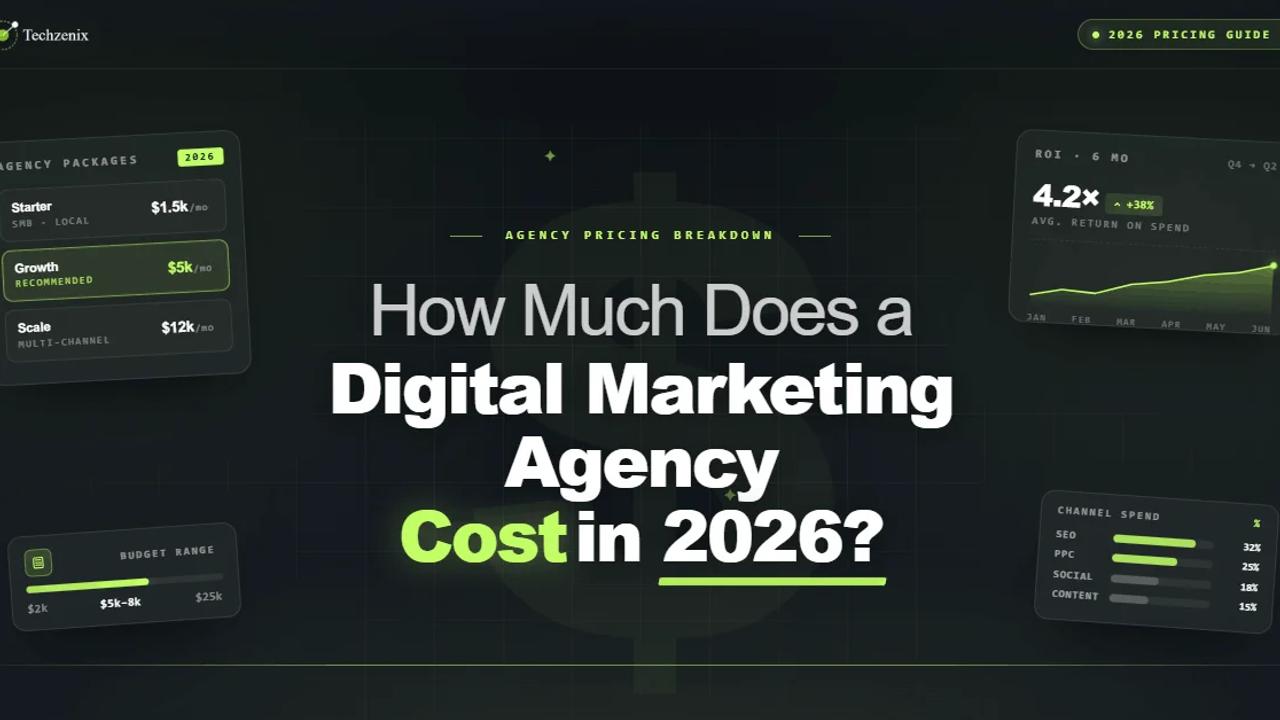
A digital marketing agency costs between $500 and $30,000+ per month in 2026, depending on scope, agency size, and geographic market. Most small businesses spend $2,500 to $7,500 per month with a competent mid-market agency. Growth-stage companies pay $7,500 to $15,000 per month for multi-channel work. Enterprise scope starts at $15,000 per month and can exceed $50,000. Anything below $500 per month is almost always automated or low-quality work that will not move the needle.
Most articles answering this question are written by agencies. They want their own pricing to look reasonable, so the ranges they publish are conveniently aligned with what they themselves charge.
This article is different. It covers the full market, from boutique agencies charging a few hundred dollars per month to enterprise firms charging six figures, and it tells you what you actually get at each tier. It also tells you what to walk away from, because at the low end of the market, the value gap is wider than the dollar gap.
This post sits in our series on hiring a digital marketing agency. For the full hiring framework, start with our pillar guide: how to hire a digital marketing agency. This post focuses on one question only: what does it cost.
What this guide covers
- The five pricing tiers in 2026, with what each tier actually buys
- The five factors that drive the price up or down
- How to budget based on your business stage and goals
- Whether agency spend is worth it (the ROI question)
- How to avoid overpaying without falling into the cheap trap
The honest answer: agency cost ranges in 2026
Digital marketing agency pricing in 2026 falls into five tiers. The ranges below are global market data based on widely reported industry benchmarks. Your actual quote will depend on the factors covered later in this post.
Two things to flag from this table. First, the jump from Tier 2 to Tier 3 is where most legitimate agency work begins. Below $2,500 per month, the agency simply does not have enough billable hours to provide strategy plus execution plus reporting at any depth. Second, the jump from Tier 4 to Tier 5 is more about team size than capability. A strong Tier 4 agency can deliver Tier 5 outcomes for a focused-scope client.
What you actually get at each tier
Industry pricing tables are useless without knowing what gets delivered for the money. Here is the realistic output expectation at each tier, based on how the math works out for the agency.
Tier 2: Boutique ($500 to $2,500 per month)
At this level the agency can afford to allocate 5 to 15 hours per month to your account, mostly junior staff with occasional strategy oversight.
- One channel: typically SEO basics or social media management
- 2 to 4 blog posts per month or 8 to 12 social posts per month
- Light monthly reporting
- Email-only support, not weekly meetings
Best fit: Single-channel businesses with patience for slow ramp. Solopreneurs and very early-stage companies.
Common mismatch: Businesses with multi-channel needs hiring at this tier and being disappointed when one channel gets attention and the rest are ignored.
Tier 3: SMB ($2,500 to $7,500 per month)
The sweet spot for most established small businesses. The agency can allocate 25 to 50 hours per month, with a mix of mid-level execution and senior strategy.
- Two to three channels: SEO plus content plus either paid media or email
- 4 to 8 blog posts per month
- Paid media management if in scope, with $2,000 to $10,000 in ad spend separate from the retainer
- Monthly strategic review meetings
- Real reporting against KPIs
- Light technical SEO work and conversion rate optimization
Best fit: Established SMBs with clear goals and $500K to $5M annual revenue. Most companies that ask this question end up in this tier.
Tier 4: Growth-stage ($7,500 to $15,000 per month)
Multi-channel, mature engagement. The agency assigns a dedicated strategist plus 3 to 5 specialists with around 80 to 120 hours of monthly attention.
- Four or more channels working in coordination
- 8 to 15 blog posts per month plus landing pages and other content assets
- Paid media at $10,000 to $50,000 monthly spend, separate from retainer
- Active link building or digital PR (10+ quality backlinks per month)
- Conversion rate optimization with formal testing
- Weekly status check-ins plus monthly strategic reviews
- Real-time dashboards, not just PDF reports
Best fit: Companies with $5M to $50M revenue, marketing-led growth strategies, and an internal marketing lead or VP marketing on the buyer side.
Tier 5: Enterprise ($15,000 to $50,000+ per month)
Full agency team allocated to your account. Often includes account management, multiple strategists, channel specialists, designers, and developers.
- Integrated strategy across 5+ channels
- Custom content production at scale (20+ pieces per month)
- Paid media management for $50,000+ in monthly ad spend
- International or multi-region work where applicable
- Custom dashboards and attribution modeling
- Quarterly business reviews with executive-level reporting
- Sometimes embedded staff or onsite work
Best fit: $50M+ revenue companies, multi-brand operations, or organizations entering new markets that need full agency capacity rather than a retainer.
INSIGHT
The tier you need is not always the tier you want. Most buyers want to spend at Tier 2 prices and get Tier 4 outputs. That math will never work. If your goals require multi-channel execution and your budget is single-channel, either narrow the goals or expand the budget. Mid-engagement disappointment usually traces back to this gap, not to the agency’s quality.
Five factors that drive the price up or down
Two agencies quoting the same scope can land $3,000 apart for the same client. Here is what causes the variance.
1. Scope of services
The single biggest driver. Single-channel scope (just SEO, just paid, just social) costs roughly 40 to 60 percent less than multi-channel scope. Adding content production, link building, conversion optimization, or analytics depth pushes the retainer up in $1,000 to $3,000 increments.
2. Competition in your niche
Ranking for keywords in a competitive niche (legal, finance, B2B SaaS, eCommerce in saturated categories) takes more effort than ranking in low-competition niches. Agencies price the effort accordingly. A local services business might pay 30 to 50 percent less than a SaaS company targeting the same volume of organic traffic.
3. Site size and technical complexity
A 30-page brochure site requires less ongoing work than a 5,000-product eCommerce store. Sites with significant technical debt (broken canonicals, JavaScript rendering issues, migration scars) cost more in the first 3 to 6 months because remediation work has to happen before growth work begins.
4. Geographic market of the agency
US-based and UK-based agencies typically charge 50 to 100 percent more than equally capable agencies based in lower-cost markets, for the same scope and quality. This is the offshore arbitrage that drives a lot of pricing variance. The tradeoff is communication overhead and time-zone alignment. For purely digital scope (SEO, paid, content), the offshore option works for most buyers.
5. Content and link inclusions
Agencies that include 4 to 8 written articles per month and 3 to 6 quality backlinks per month cost noticeably more than audit-only or strategy-only retainers. Quality backlinks alone cost $80 to $400 per link through ethical outreach. Five included links per month means roughly $1,000 of pass-through cost embedded in the retainer.
2026 WILDCARD
AI tools have changed agency economics in 2026. Agencies that have integrated AI into briefing, research, and first-draft production can deliver more output per billable hour, which compresses the price-quality curve. Buyers should ask agencies how they use AI in delivery. Agencies that use it well can sometimes offer Tier 3 outputs at Tier 2 prices. Agencies that have not adopted yet are quietly losing competitive ground.
How to budget for your situation
Two practical frameworks help you decide what to spend.
Framework A: Marketing spend as a percentage of revenue
Most industry surveys put healthy marketing spend at 7 to 12 percent of revenue for growth-stage companies, and 5 to 8 percent for mature businesses. Of that total, somewhere between 30 and 60 percent typically goes to external agency work, with the rest covering tools, in-house staff, and ad spend.
Framework B: Customer lifetime value (LTV) multiples
If you know your average customer LTV and your current CAC, you can work backwards from how many new customers the agency would need to bring in to pay back the engagement. A useful rule of thumb: agency spend should pay back within 4 to 6 months of customer LTV in B2B, and within 2 to 4 months for eCommerce or B2C.
Example: An SMB with $4,000 customer LTV and a goal of 10 new customers per month would generate $40,000 in monthly LTV. Spending up to $8,000 per month on the agency (20 percent of attributed LTV) is reasonable. Above that, the math gets tight unless retention or LTV improves.
Is hiring an agency actually worth the cost?
Two angles to answer this honestly.
When agency spend pays back
Agencies tend to deliver clear ROI when the business has:
- A working product or service (marketing amplifies what already converts)
- Tracked CAC and LTV (you can measure the payback)
- Patience for the channel ramp (SEO needs 6 to 12 months; paid media moves faster)
- Clear goals (the agency knows what to optimize for)
- Internal capacity to act on agency recommendations (a brilliant strategy nobody implements is worth zero)
When agency spend disappoints
Agencies struggle to deliver when:
- The offer or product has poor conversion that marketing cannot fix
- Goals shift every 2 to 3 months
- Internal stakeholders do not respond to agency requests for inputs or approvals
- The retainer is too small for the goal (Tier 2 budget, Tier 4 expectations)
- The buyer expects revenue impact in month 2 from organic SEO work that needs 6 to 9 months
Typical payback timelines by channel
How to avoid overpaying without falling into the cheap trap
Three rules cover most of the risk.
Rule 1: Pricing should map to specific outputs
Ask any agency to show you what specific work happens for the money. “We will do SEO” is not an output. “We will publish 6 blog posts, fix 12 technical issues, and earn 4 backlinks per month” is. The clearer the deliverables, the less likely you are overpaying for vague effort.
Rule 2: Avoid the very low end
Below $500 per month for digital marketing is almost always one of three things: automated work using off-the-shelf tools, outsourced execution by people two or three layers removed from your account, or low-quality tactics that will cause problems in 12 to 18 months. The lower the price, the more likely you will pay for it later in lost rankings or wasted time. Our breakdown of red flags when hiring a digital marketing agency covers what to watch for at the cheap end of the market.
Rule 3: Compare apples to apples
When two agencies quote different prices, compare them on actual scope, not headline numbers. One $5,000 retainer with 6 articles and 5 links included is very different from a $5,000 retainer that is strategy and reporting only. For a structured way to compare proposals across multiple agencies, see how to evaluate a digital marketing proposal.
If you want a deeper look at pricing structures themselves (retainer vs project vs performance-based vs hybrid), our companion post on digital marketing agency pricing models covers each model with the tradeoffs.
Frequently asked questions
What is the average cost of a digital marketing agency in 2026?
Most small to mid-sized businesses spend $2,500 to $7,500 per month on a digital marketing agency. Growth-stage companies spend $7,500 to $15,000. Solo founders and very small businesses can get value at $500 to $2,500 for single-channel work, but most multi-channel scope realistically starts at $2,500.
Why do digital marketing agency prices vary so much?
Five main factors: the scope of services included, how competitive your niche is, the size and complexity of your website, the geographic market of the agency, and whether content production and link building are included or charged separately. Two agencies quoting the same scope can land thousands of dollars apart because of these variables.
Is it cheaper to hire a digital marketing agency or build an in-house team?
It depends on budget. Below $7,500 per month, an agency almost always wins on cost-per-channel because you get fractional access to multiple specialists. Above $15,000 per month, an in-house team starts to compete on total economics, though it loses on speed of setup and cross-account intelligence. The full math is in our breakdown of in-house marketing versus agency.
How much should a small business spend on digital marketing per month?
A reasonable benchmark is 7 to 10 percent of annual revenue on total marketing, with 30 to 60 percent of that going to external agency work. A small business doing $1 million in revenue would budget $70,000 to $100,000 per year on marketing, with roughly $2,500 to $5,000 per month available for agency work after tools and ad spend.
Are offshore digital marketing agencies cheaper?
Yes. Agencies based in lower-cost markets typically charge 50 to 70 percent less than US or UK agencies for equivalent scope and quality. The tradeoff is time-zone overlap and communication style. For purely digital work (SEO, paid media, content production), offshore agencies work well for most buyers. For PR or local-market activation, staying onshore is usually better.
What is the minimum I should spend on a digital marketing agency to get real results?
For single-channel work with patience, $1,000 to $2,500 per month can produce results from a competent boutique agency. For meaningful multi-channel work that actually moves business metrics, $2,500 to $5,000 per month is the realistic floor. Below $1,000 per month, you are almost always better off hiring a senior freelancer for a focused project than retaining an agency.
Can I negotiate digital marketing agency pricing?
Yes, in two ways. First, scope: removing services you do not need or do not value will reduce the retainer. Second, commitment: most agencies offer a discount of 10 to 20 percent for 12-month commitments compared to month-to-month engagements. Discounts for prepayment also exist at some agencies. What does not usually negotiate is hourly rates or per-deliverable pricing on tightly defined scope.
Do digital marketing agencies offer free trials?
Free trials are uncommon because the strategy and onboarding work in the first month is real labor that an agency cannot give away. Some agencies offer paid pilot engagements (a 30 to 90 day reduced-scope start), and many offer free audits or strategy sessions as a pre-engagement courtesy. A free audit is a good way to evaluate fit without committing to a retainer.
How does AI affect digital marketing agency pricing in 2026?
AI tools have compressed the price-quality curve. Agencies that have integrated AI into their workflows (research, briefing, first drafts, optimization) can deliver more output per billable hour, which lets them either lower prices or include more in the retainer. Buyers should ask agencies how they use AI in delivery. Agencies that say “we do everything by hand” are usually charging a premium for a workflow that AI-augmented competitors do faster.
Where to go from here
If you have a sense of the right budget for your situation, the next step is to start the agency search. Our pillar guide walks through the full 9-step process from current-state audit to signed contract.
If you would like a custom recommended budget range based on your actual goals, traffic, and competitive position, we offer a free audit. We review your current marketing state and send a written report with a recommended monthly investment range for your situation. No commitment to engage required.

Ali Hamza is an SEO specialist and digital marketer with 7+ years of experience in SEO, content strategy, WordPress, and online growth marketing. He shares practical insights and industry-based strategies focused on improving search visibility, user experience, and long-term organic growth.