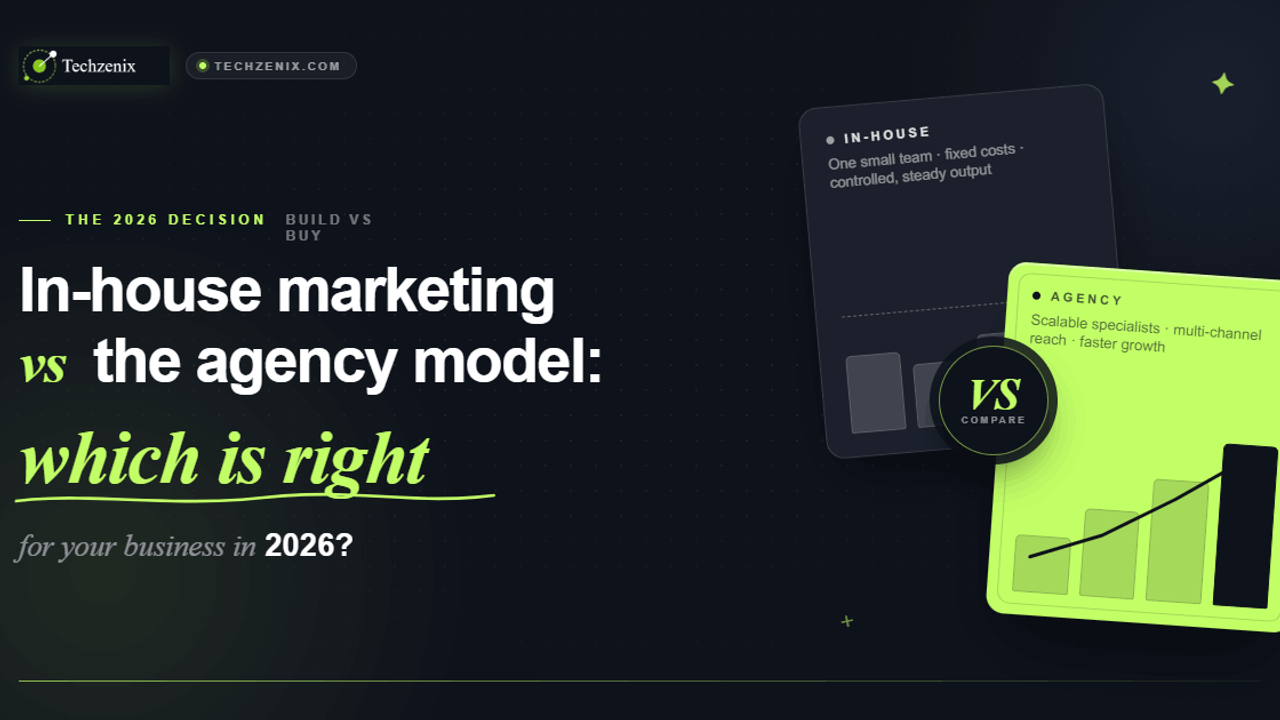
Discover the key differences between in-house marketing and hiring an agency, including costs, expertise, scalability, and control. Learn which model works best for your business goals and growth strategy.
QUICK ANSWER
In-house marketing wins when you have $15,000+ per month available for fully loaded marketing costs (salaries, benefits, tools), need deep institutional knowledge of a complex product, and can wait 90+ days for output to begin. A marketing agency wins when you need speed to results, multi-channel coverage on a tighter budget, or specialist skills you cannot hire affordably as full-time roles. Most growth-stage companies eventually run both: a senior in-house marketing lead plus an agency on retainer for execution capacity and specialist depth.
This is one of the highest-stakes decisions in marketing leadership. Choose wrong and you spend 12 to 18 months realizing the model does not fit, by which point you have burned six figures and lost market share to a competitor who chose better.
The honest answer is that neither option is universally better. The right answer depends on your stage, your budget, your timeline, and the complexity of your product. Below is the side-by-side comparison across 10 dimensions, the situations where each option wins clearly, and the hybrid model that most growth-stage companies converge to within 24 months.
This post sits in our series on hiring a digital marketing agency. For the full hiring framework once you have decided in favor of an agency, see our pillar guide: how to hire a digital marketing agency. For just the cost question, see how much does a digital marketing agency cost.
What this guide covers
- Quick comparison at a glance
- What in-house marketing actually means in 2026
- What hiring a marketing agency actually means in 2026
- Side-by-side comparison across 10 dimensions
- When in-house wins clearly
- When an agency wins clearly
- The hybrid model and why most growth companies end up there
- A 5-question diagnostic to decide for your situation
Quick comparison at a glance
The full breakdown is below. If you want the shortest possible version of the comparison, this table covers the dimensions that matter most for the decision.
What in-house marketing actually means in 2026
An in-house marketing team is a group of full-time employees on your payroll, dedicated to your company’s marketing needs. The smallest viable in-house team is one full-time marketing manager. The most common configuration for SMBs is a marketing manager plus one specialist (paid media, SEO, or content). Growth-stage companies typically run a head of marketing plus 2 to 4 specialists.
What sits on your books with an in-house team: salaries, benefits and payroll taxes (typically 25 to 35 percent above base salary in the US), software and tools, training budgets, recruitment costs, and the management overhead of having direct reports.
What you get in return: dedicated focus on your company, deep institutional knowledge over time, direct cultural alignment, and full control over priorities.
What hiring a marketing agency actually means in 2026
A marketing agency is an external partner providing fractional access to a team of specialists, paid through a monthly retainer or project fee. You are not hiring individuals; you are hiring outcomes, with the agency assembling the right mix of strategists, specialists, and execution staff to deliver against the scope.
What you pay for: the agency’s pooled time, their tool stack, their existing methodologies, and the cross-account intelligence they bring from working across many clients simultaneously.
What you give up: dedicated attention (you share the team with other clients), full cultural immersion (no agency person can be as immersed as a full-time employee), and direct day-to-day management control.
Side-by-side comparison across 10 dimensions
This is the section to read carefully if you are actually deciding. Each dimension has a winner, but the winner often depends on context. Where the comparison is conditional, the conditions are spelled out.
1. Cost at multi-channel scope
Winner: Agency, in most realistic scenarios. A US-based marketing manager costs $70,000 to $95,000 base salary, or roughly $90,000 to $125,000 fully loaded with benefits. A senior marketer (head of marketing) costs $130,000 to $190,000 fully loaded. Adding one specialist (paid media manager or SEO specialist) adds another $80,000 to $130,000 fully loaded. The lowest viable in-house team for multi-channel work runs about $250,000 per year, or $20,000+ per month. A competent agency delivers comparable multi-channel scope for $7,500 to $15,000 per month. Below $20,000 monthly marketing budget, the agency wins on pure cost-per-channel almost every time.
2. Speed to first output
Winner: Agency, decisively. Hiring even a single in-house marketer takes 60 to 120 days from job posting to ramped output: 30 to 60 days to recruit, 30 to 60 days to onboard, and another 30 days before the new hire produces meaningful work. An agency starts producing within 7 to 21 days of contract signature because the team, tools, and methodologies already exist. If your situation has a deadline (product launch, competitive pressure, seasonal opportunity), the speed difference alone justifies the agency model.
3. Specialist depth
Winner: Agency for breadth, in-house for depth on one channel. A modern marketing operation needs strategists, copywriters, designers, paid media specialists, SEO technical leads, analytics specialists, and conversion optimizers. Hiring all six in-house as full-time roles is impossible below $80,000 per month in fully loaded costs. An agency provides fractional access to all six for a small fraction of that. The exception: if your business depends on extreme depth in one specific channel (a SaaS company that lives or dies on paid media, for example), one in-house specialist with full focus can outperform a fractional agency specialist who is splitting attention.
4. Strategic continuity
Winner: In-house, on average. An in-house team accumulates knowledge about your product, your customers, your market, and what has been tried in previous campaigns. That continuity compounds over years. Agency strategists turn over more often: account managers leave, your strategist gets promoted to another account, the agency loses talent to competitors. Strategic continuity is one of the genuine arguments for in-house, particularly for companies with complex products or long sales cycles.
5. Accountability and ownership
Tie, depending on contract structure. In-house teams are accountable through standard employment management. Agencies are accountable through written KPIs, monthly reporting, and exit clauses. Both can be excellent or terrible depending on how the relationship is structured. The accountability difference most buyers miss: it is psychologically easier to fire an agency than an in-house team, which can be a feature or a bug depending on your management style.
6. Tooling and data infrastructure
Winner: Agency, until your in-house team reaches scale. Marketing tools cost real money. A serious in-house operation needs Ahrefs or SEMrush ($200 to $400 per month), Google Analytics 4 plus a paid analytics layer like Mixpanel or Amplitude ($0 to $1,500 per month), Surfer or Frase for content ($80 to $200 per month), HubSpot or another CRM ($800 to $3,000 per month), session recording tools, attribution platforms, and project management software. The fully loaded tool stack for an in-house team runs $1,500 to $4,000 per month. Agencies bundle these into the retainer because they amortize the cost across many clients.
7. Brand and cultural depth
Winner: In-house. An in-house marketer absorbs the company culture, learns the product through internal exposure, builds relationships with engineering and sales, and develops intuition about brand voice over time. No agency person can replicate this depth because they split attention across many clients. For brand-led businesses where voice and consistency matter heavily, this gap is real and worth pricing in.
8. Cross-account pattern recognition
Winner: Agency, by a wide margin. This is the underrated reason mature companies keep agencies on retainer even when they have full in-house teams. An agency working across 30 to 80 active accounts sees what is working right now across many industries. Which Meta ad creative formats are quietly losing performance, which Google SERP features are shifting, which AI Overview citation patterns are emerging. An in-house team sees one company’s data. That cross-account intelligence is the single biggest reason in-house leaders eventually add an agency rather than removing one.
9. Scaling flexibility
Winner: Agency, decisively. Scaling an in-house team requires hiring cycles (60 to 120 days) and severance costs to shrink. Scaling agency capacity requires a contract amendment that can be processed in days. If your business has seasonality, project-based intensity, or unpredictable growth, the agency model gives you elasticity that an in-house team cannot match without overstaffing.
10. Institutional knowledge retention
Winner: In-house, by definition. When an in-house employee leaves, the knowledge stays partially behind in documents, systems, and team memory. When an agency engagement ends, the knowledge largely walks out with the agency. Companies that switch agencies every 2 to 3 years often discover they have lost continuity in ways that are hard to recover. Mitigating this requires explicit knowledge transfer agreements in the contract, which most buyers forget to ask for.
When in-house marketing wins clearly
Five situations where the in-house model is the right answer.
- Your annual marketing budget is above $400,000. At this level the math starts to favor in-house because you can hire a head of marketing plus 2 to 3 specialists and absorb the tool costs without losing scale economics.
- Your product is complex and requires deep technical or industry knowledge to market well. SaaS platforms, regulated industries (finance, healthcare, legal), and highly technical B2B all benefit from marketers who can speak the language fluently.
- Brand voice and editorial consistency are core to your differentiation. If your content marketing is the primary product (publishing companies, media brands, content-led communities), the depth of in-house ownership matters more than the breadth an agency provides.
- You have a long sales cycle (6+ months) where institutional knowledge of accounts and pipeline compound over time.
- You have already tried agencies and consistently been disappointed, after honest reflection that the cause was fit and not your own inputs.
When an agency wins clearly
Five situations where the agency model is the right answer.
- Your annual marketing budget is below $200,000. At this level the in-house math does not work for multi-channel coverage; you would be forced to hire one generalist who is mediocre at five things.
- You need speed to results. A product launch, seasonal opportunity, or competitive defense that needs work starting next month favors the agency model decisively.
- Your scope spans 4 or more channels. Each additional channel makes the in-house option more expensive because you need either generalists who are weak everywhere or specialists who are expensive everywhere.
- Your business has seasonality or project-based intensity. Scaling capacity up and down through retainer adjustments is easier than hiring and severance cycles.
- You are pre-series A or self-funded and cannot commit to a 12-month hiring runway with severance risk.
Why most growth-stage companies end up running both
The single most common destination for marketing operations as they mature is the hybrid model: a senior in-house marketing leader plus an agency on retainer. This is not a compromise; it is the actual best practice for companies that can afford it.
How the hybrid model works
The in-house head of marketing owns strategy, brand voice, internal coordination, and accountability to the rest of the executive team. The agency provides execution capacity, specialist depth, tooling, and cross-account intelligence. Most operational marketing work runs through the agency; most strategic decisions are owned in-house.
Typical hybrid budget allocation
Why this works better than either extreme
Pure in-house teams hit specialist depth and bandwidth limits that take years to fix through hiring. Pure agency engagements struggle with strategic continuity and cultural alignment. The hybrid model gives you the institutional knowledge and accountability of in-house leadership plus the execution capacity and cross-account intel of an agency. The transition cost from either pure model to hybrid is low; you keep what works and add what is missing.
A 5-question diagnostic to decide for your situation
Answer these five questions honestly. The pattern of your answers points clearly toward one model.
Question 1: What is your monthly marketing budget?
- Under $7,500 per month: Agency is almost always the right answer
- $7,500 to $20,000 per month: Agency, with the option to add an in-house lead as you grow
- $20,000 to $35,000 per month: Either model works; depends on the other four questions
- Above $35,000 per month: Hybrid model is usually optimal
Question 2: How quickly do you need output?
- Within 30 days: Agency
- Within 60 to 90 days: Either, but agency is lower risk
- No time pressure (6+ months acceptable): Either model works
Question 3: How complex is your product?
- Simple product or service (consumer goods, local services, common SaaS categories): Agency works well
- Moderate complexity (specialized B2B, technical SaaS, regulated industries with clear rules): Either, with bias toward in-house for the depth
- High complexity (deep technical, multi-stakeholder enterprise sales, custom solutions): In-house lead at minimum, ideally hybrid
Question 4: How many channels do you need to cover?
- 1 to 2 channels: Either, depending on budget
- 3 to 4 channels: Agency is usually the better economic answer
- 5+ channels: Agency, or hybrid if budget allows
Question 5: How comfortable are you managing external partners?
- Very comfortable, prefer it: Agency wins
- Mixed feelings: Hybrid wins
- Strongly prefer direct management of staff: In-house wins
NEXT STEP
If you score 4 or 5 toward agency, move on to the agency selection process. Our pillar guide on how to hire a digital marketing agency covers the full 9-step framework from current-state audit to signed contract.
Frequently asked questions
Is in-house marketing cheaper than an agency?
It depends on scope. For single-channel work, an in-house specialist can be cheaper than a comparable agency engagement. For multi-channel work, an agency is almost always cheaper than the equivalent in-house team because of fractional access to specialists. The break-even point is roughly $20,000 per month in budget; below that, agencies win on cost; above that, in-house starts competing on total economics.
How long does it take to build an in-house marketing team?
Hiring a single marketer takes 60 to 120 days from job posting to ramped output. Building a team of 3 to 4 marketers takes 6 to 12 months because hires need to be staggered to allow proper onboarding. By contrast, an agency engagement begins producing within 21 days of signing.
Can a startup afford an in-house marketing team?
Most pre-Series A startups cannot afford a meaningful in-house marketing team. The minimum viable team (one marketing manager) costs $90,000+ per year fully loaded, which is significant payroll commitment for a company without predictable revenue. Most startups start with one founder doing marketing, then move to a freelancer or agency, and only build in-house after Series A when capital and stability support it.
Why do some companies use both an in-house team and an agency?
The hybrid model gives you the institutional knowledge and brand depth of in-house leadership plus the execution capacity and cross-account intelligence of an agency. Most companies above $400,000 annual marketing budget converge to this model within 24 months because it outperforms either pure model on the dimensions that matter.
When should I switch from agency to in-house?
Consider the switch when your monthly agency spend exceeds $15,000 per month, your scope has narrowed to 1 to 2 channels you understand deeply, you have predictable revenue to support full-time payroll, and you have the management bandwidth to hire and develop a team. A common pattern is moving the channel you understand best in-house while keeping the agency for everything else.
What is the cheapest way to start: in-house, agency, or freelancer?
For under $2,000 per month, a senior freelancer is usually the most cost-effective starting point. For $2,000 to $7,500 per month, an agency provides better breadth than a single in-house junior hire. Above $20,000 per month, an in-house team or hybrid model usually outperforms a pure agency engagement. For a deeper comparison see our post on freelance vs agency.
Can AI tools replace the need for either option?
Not yet, but they have changed the math. AI tools allow a single skilled in-house marketer to produce what required a small team in 2022. This pushes the break-even point where in-house becomes economically viable lower than it used to be. AI does not replace strategy, brand judgment, or relationship-driven work like outreach and partnerships. It changes the economics of execution, not the need for human ownership of decisions.
What is the right first marketing hire for a growing company?
The first dedicated marketing hire should almost always be a senior generalist (a head of marketing or marketing director) rather than a junior specialist. A senior generalist can manage external partners, set strategy, and identify what to hire or outsource next. A junior specialist requires senior oversight that the company does not yet have, which is why early specialist hires often fail to produce results.
Where to go from here
If you would like a second opinion on whether your situation is better suited to in-house, agency, or hybrid, we offer a free strategy call. We will review your current marketing state, budget range, and goals, then give you an honest recommendation, including the option that does not involve hiring us. No commitment required.

Ali Hamza is an SEO specialist and digital marketer with 7+ years of experience in SEO, content strategy, WordPress, and online growth marketing. He shares practical insights and industry-based strategies focused on improving search visibility, user experience, and long-term organic growth.